
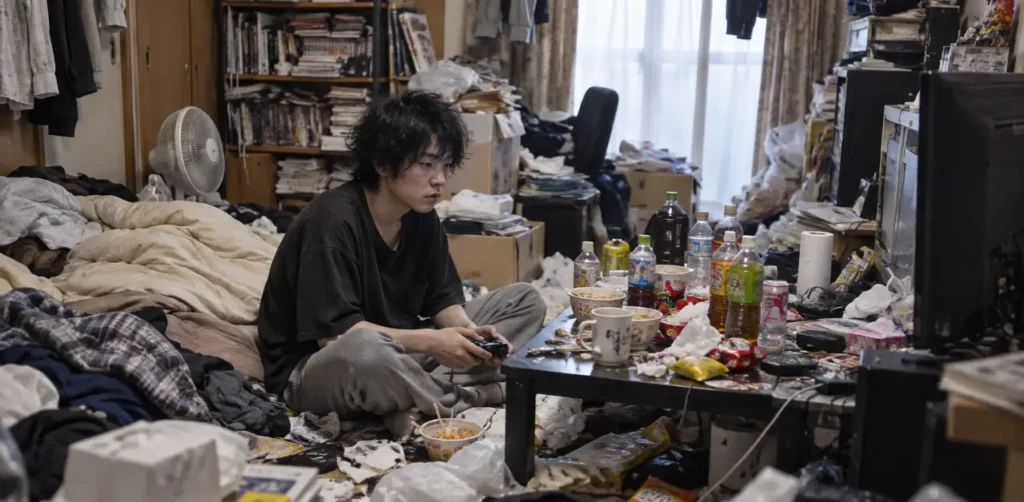
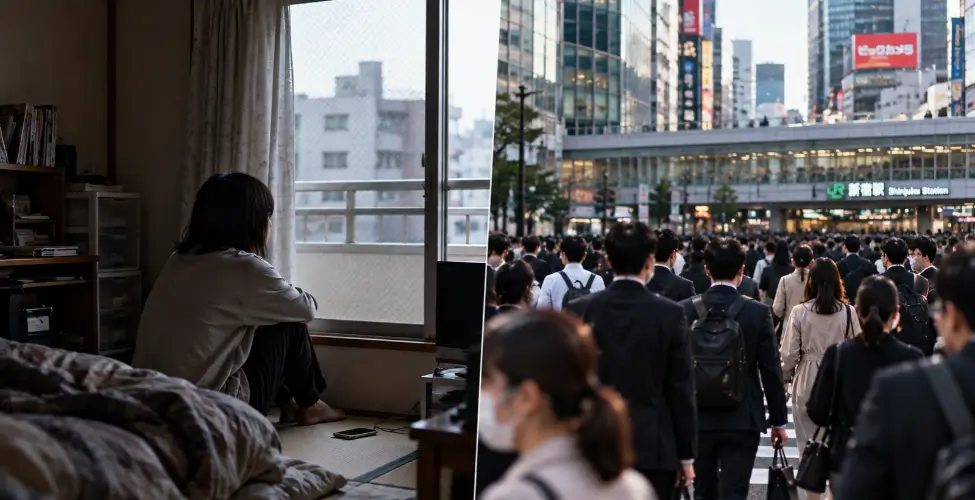
Most people’s picture of Japan involves packed trains, busy crossings and cities that never seem to empty. It’s much harder to picture the people in those same cities who have almost stopped taking part in ordinary life. They aren’t working or studying, and some have lived like this for years.
Japanese has a word for them. Hikikomori comes from a verb meaning to withdraw or shut yourself away, and English speakers usually translate it as social withdrawal.
Japan’s Cabinet Office carried out a national survey in 2022 and published the results in 2023. It estimated that about 1.46 million people aged 15 to 64 were living in a broad hikikomori state. That’s roughly one person in every 50 in that age group, and the detail behind the number is more surprising still.
What the word actually covers
The stereotype is a teenage boy locked in his bedroom, but the official definition reaches much further. The Cabinet Office survey went out in November 2022 to 30,000 randomly chosen people aged 10 to 69, and around 13,800 replied.
It counted someone as hikikomori if they’d spent at least six months in one of four situations. Some only went out for errands linked to a hobby, and others went no further than the local convenience store. A third group left their room but never the house, while the fourth barely left their room at all.
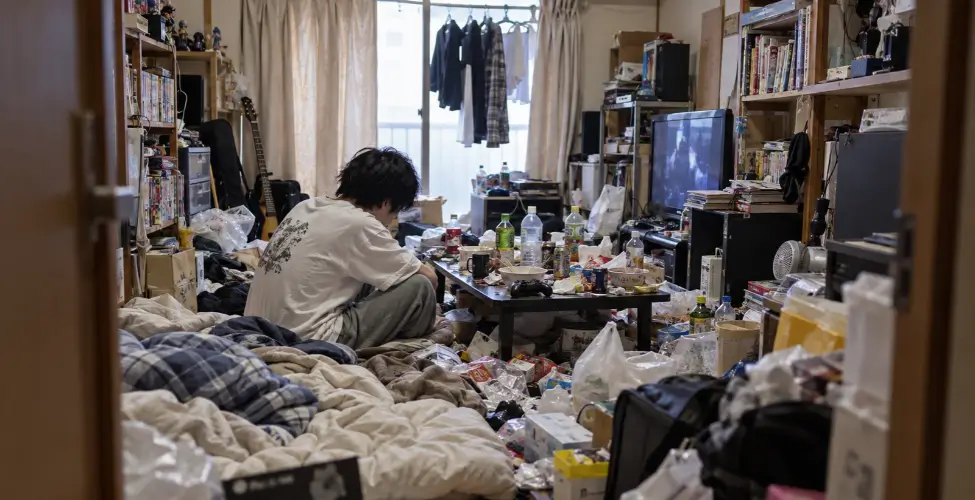
The survey excluded anyone in work and anyone kept at home mainly by physical illness. It also left out homemakers and people staying in because of pregnancy or childcare, but only if they still talked fairly regularly with people outside the family.
So hikikomori doesn’t mean never going outside. The health ministry’s 2010 guideline calls it a phenomenon, a state that a person is in. Under that guideline, someone avoids school, work and socialising outside the home for six months or more. They can still go out, as long as the outing doesn’t involve contact with other people.
Ministry material adds that the word describes a person’s situation, not the person themselves. In its view, the real problem isn’t the withdrawal so much as the lost connection and the distress that goes with it.
How many people, and who they are
Just over 2% of respondents in both age groups met the definition. The figure was 2.05% for people aged 15 to 39 and 2.02% for those aged 40 to 64. Withdrawal, in other words, was just as common among middle-aged respondents as among younger ones.
The gender split challenged the old image as well.
| Age group | Men | Women |
|---|---|---|
| 15 to 39 | 53.5% | 45.1% |
| 40 to 64 | 47.7% | 52.3% |
Women actually made up a slight majority of the older group. Earlier surveys painted a far more male picture. In the 2015 survey of 15 to 39 year olds, men made up 63.3% of the withdrawn group. In the 2018 survey of 40 to 64 year olds, they made up 76.6%.
The 2022 survey also changed who it counted. Earlier versions didn’t include homemakers who stayed at home because of family responsibilities. The 2022 version did include them if they rarely talked with anyone outside the family. The figures alone can’t show how much of the shift comes from that change, but the official picture today looks very different from the stereotype.
Is it getting worse?
Earlier surveys estimated 541,000 people aged 15 to 39 in 2015 and 613,000 aged 40 to 64 in 2018. Together that comes to about 1.15 million, which is below the 2022 estimate. The government warned, though, that changes in the questions make a direct comparison unreliable. The 2022 survey was also the first to cover young and middle-aged people together, so there’s no perfect earlier benchmark.
What the survey does show clearly is how long withdrawal can last. About one in six people in it had been withdrawn for ten years or more. That was 17.4% of the younger group and 15.5% of those aged 40 to 69.
Where the idea came from
The term turned up in a government youth white paper in 1990, which listed hikikomori among young people’s non-social problem behaviours. It reached a much wider audience after psychiatrist Tamaki Saito published Shakaiteki Hikikomori (Social Withdrawal) in 1998. A national federation of family groups, known as KHJ, formed soon afterwards.
Early official guidance reflected that focus on youth. In 2001 the health ministry issued interim guidelines on hikikomori among people in their teens and twenties, and a final version followed in 2003.
The young people of that era grew older, of course. When the ministry later explained why it needed a new approach, it pointed to surveys revealing middle-aged hikikomori. It also highlighted households struggling with more tangled problems, including what Japan calls the 8050 problem.
Why people withdraw
There’s no single cause, and the survey’s own figures make that plain. Asked for the biggest reason behind their situation, people aged 15 to 39 gave a wide spread of answers.
- Leaving a job (14.9%)
- Relationship difficulties (14.0%)
- The COVID-19 pandemic (12.3%)
- Illness (10.5%)
- Not attending junior high school (9.6%)
- Pregnancy (7.0%)
Among people aged 40 to 69, one answer stood well apart from the others. Leaving a job accounted for 42.2%, far ahead of COVID-19 at 17.0% and illness at 14.8%. Relationship problems (6.7%) and taking on care for a family member (5.2%) also appeared.
When people could pick more than one reason, around one in five named the pandemic. That was 18.1% of the younger group and 19.8% of those aged 40 to 64. A Cabinet Office official suggested that when going out became difficult, online classes and remote work made isolation easier to slip into. The same official said hikikomori could happen to anyone.
What stands out is how ordinary most of these reasons are. People rarely describe a dramatic decision to leave society. They describe losing a job, falling ill or struggling with the people around them.
The link with school non-attendance
One route starts early. Japan uses the term futōkō for pupils who miss 30 days or more of school in a year for reasons other than illness.
In the 2024 school year, a record 353,970 elementary and junior high pupils fell into that category, 3.9% of all pupils. It was the twelfth annual rise in a row, although the education ministry noted that new cases fell for the first time in nine years. Futōkō isn’t the same as hikikomori, but missing junior high school does appear among the reasons younger hikikomori give.
The employment ice age
Work comes up again and again in the survey, especially among older respondents, so one generation deserves a closer look. Japan calls people who job-hunted roughly between 1993 and 2004 the employment ice age generation, or shūshoku hyōgaki sedai. They went looking for work when jobs were scarce after the bubble economy burst. Many still face insecure work they didn’t choose, or long spells without work at all.
Government figures for 2025 put the number of people from this generation who weren’t working at about 460,000, an increase of 50,000. Another 330,000 were in non-regular jobs they didn’t want. Not everyone in those figures is withdrawn, of course.
The government agreed a new support framework in June 2025. In April 2026 it adopted a three-year programme running to the 2028 financial year. One of its three strands offers step-by-step support towards social participation, including places where people can simply spend time. The other two cover work and preparing for later life, such as household finances and housing.
None of this makes the ice age a single explanation for hikikomori. It does show how a bad start in the job market can still shape lives decades later.
Families, ageing parents and the 8050 problem
Families sit at the centre of the hikikomori story. Health ministry guidance notes that families often carry the problem alone for years and only ask for help after long hesitation. It also says supporting the family is often the best way to reach the withdrawn person.
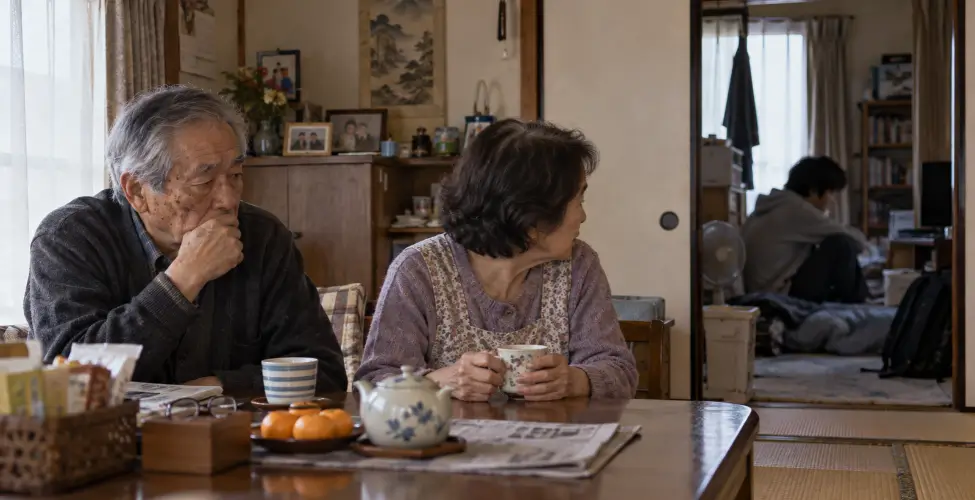
As both generations age, that arrangement gets harder to sustain. The 8050 problem describes a household where parents in their 80s support a child in their 50s, often on the parents’ pension. It usually arises because the child’s withdrawal has lasted into middle age.
The ages are creeping up. A 2025 survey by the KHJ federation drew responses from 278 families and 101 people with personal experience of hikikomori. In the family responses, the withdrawn person averaged 36.9 years old and family members averaged 66.3. Among people answering for themselves, the average age was higher still, at 43.5. Families also said they worried about what would happen once the parents died. The survey isn’t nationally representative, but it shows how far hikikomori has moved beyond the old image of a youth problem.
Some politicians and commentators have already started talking about a 9060 problem as these households grow older still.
So what happens when the parents die? National figures on that question are hard to find. The 2025 support handbook does, however, ask support workers to plan ahead for life after the parents are gone.
Is hikikomori only a Japanese thing?
The word is Japanese, and researchers describe the phenomenon as first reported in Japan. Similar long-term withdrawal has since been reported in places including Hong Kong, Oman, Spain, Italy, France and China. A study using one standard definition identified cases in India, Japan, South Korea and the United States, with high levels of loneliness and impairment.
South Korea offers the closest comparison. Its health ministry estimates around 540,000 isolated young adults aged 19 to 34. About 240,000 of them are reclusive and rarely leave home at all. Seoul announced its first government-wide support plan for them in December 2023. Korea defines the problem differently, though, so the numbers don’t line up neatly with Japan’s.
Japan may simply have named and measured something early that other countries are now starting to recognise.
How Japan’s response is changing
Regional hikikomori support centres began opening in 2009, and by April 2018 every prefecture and major city had one. From 2022, local councils could also run their own centres or support stations. In the 2024 financial year, 303 municipalities ran a dedicated hikikomori programme. By the end of that year, around nine in ten local authorities had named a place where people could ask for help.
The biggest shift concerns the goal itself. In January 2025 the health ministry issued a new handbook for anyone supporting withdrawn people and their families. It says the aim is for people and their families to decide for themselves how they want to live and relate to society. Getting a job or rejoining social life counts as part of that process, not the only goal.
The handbook also drops any minimum period of withdrawal. Instead, it covers people who feel isolated, face difficulties in life and have little contact with others, including their own families. That change sits alongside a wider one. Japan’s Act on the Promotion of Measures against Loneliness and Isolation came into force in April 2024.
What hikikomori says about Japan today
Seen up close, hikikomori connects with several of the biggest changes in Japanese society. Job losses and a generation that started out in the employment ice age tie it to work. Parents in their 80s supporting middle-aged children tie it to ageing. Japan now even treats loneliness and isolation as a matter for national law.
The official figures also undo several stereotypes at once. A hikikomori isn’t necessarily young, male or shut in a bedroom. Women make up a slight majority of withdrawn people aged 40 to 64, and the official definition includes people who still go out for hobbies or a trip to the shop.
What links these very different lives isn’t one cause. It’s the slow loss of connection with work, school and other people, which is exactly what Japan’s newest guidance now tries to rebuild, one person and one family at a time.
Sources:
- Cabinet Office minister’s press conference, 10 April 2026
- KHJ 2025 survey announcement
- KHJ press release and survey extract (PDF)
