

Every time you tap through a ticket gate in a Japanese city, there’s a decent chance you’re paying more than you need to. Most visitors stick to single rides on an IC card without checking whether a day pass would be cheaper. Japan City Day Passes solve this, and on weekends and holidays several get cheaper still. Knowing they exist changes how you plan a day out.
When a day pass actually makes sense
These passes work on simple maths.
Most city subway fares in Japan sit around ¥210 to ¥250 per ride.
A typical day pass costs somewhere between ¥520 and ¥870.
That means you break even after three or four journeys.
If you’re bouncing between sightseeing spots across a city, you’ll hit that number before lunch.
The weekend and holiday versions take it further.
Several cities drop the adult price on Saturdays, Sundays and national holidays, sometimes by a couple of hundred yen.
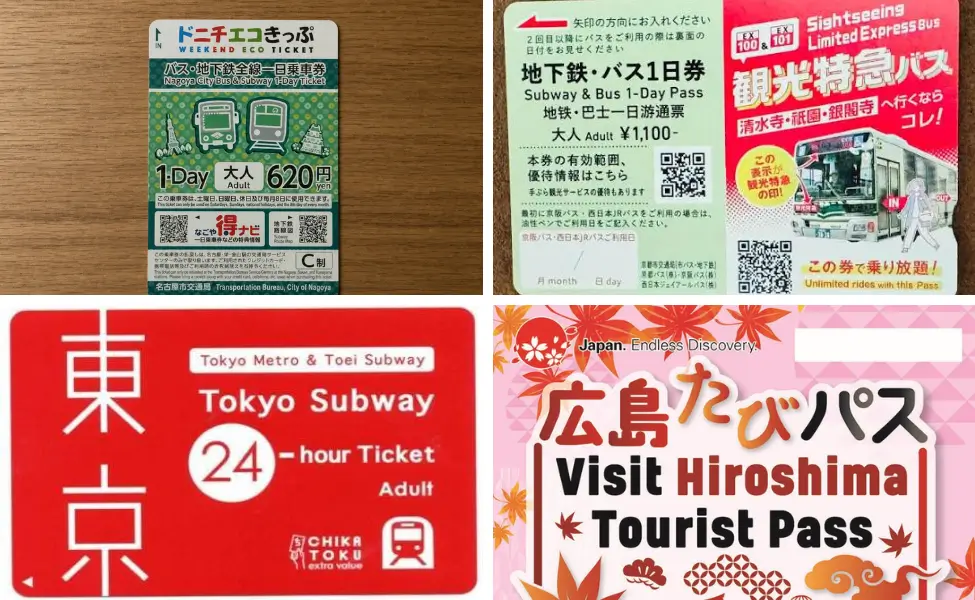
That’s not going to change your life, but it’s a decent saving for doing absolutely nothing different.
Some passes also get you discounts at attractions when you show them at the entrance. More on that below.
Nagoya’s Donichi Eco Kippu: the best of the lot
Nagoya’s weekend pass is called the Donichi Eco Kippu, which roughly translates as “Saturday-Sunday Eco Ticket.”
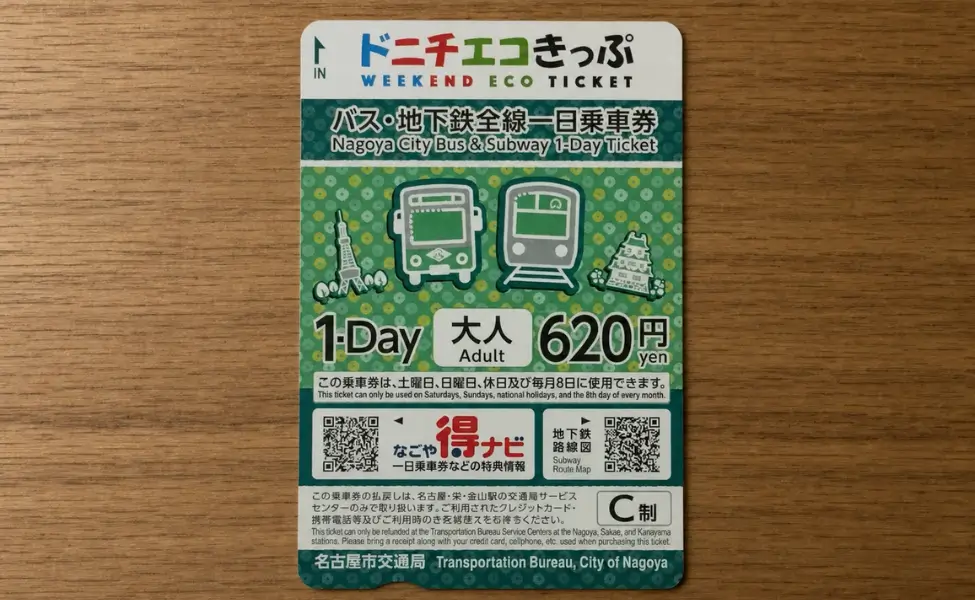
It costs ¥620 for adults and ¥310 for children, and it covers all Nagoya City Subway lines and all Nagoya City Bus routes for the entire day.
It’s valid on Saturdays, Sundays, national holidays, days running on the special holiday timetable, and the 8th of every month.
That monthly 8th-of-the-month option is something a lot of people miss entirely, including a fair amount of English-language content about the pass.
You break even after three subway trips at the standard ¥210 base fare.
Most days out in Nagoya will involve more than that.
What makes this pass stand out from similar tickets in other cities is the bus coverage.
At ¥620, you get both the subway network and city buses.
Most comparable passes in other cities only cover the subway, or charge more for the combined option.
The pass doesn’t cover everything.
Meitetsu trains, Meitetsu Bus, the Aonami Line, and most of the elevated Yutorito Line section from Ozone to Obata Ryokuchi are all excluded.
Younger passengers get an exception on the Yutorito Line, but adults need separate tickets for those operators.
Discounts worth knowing about
Showing a valid Donichi Eco Kippu at the entrance gets you money off several attractions around the city.
Nagoya Castle knocks ¥100 off the adult admission.
Higashiyama Zoo and Botanical Gardens does the same.
The Tokugawa Art Museum takes ¥200 off for adults.
There are other participating shops and restaurants too.
Over the course of a full day out, those small reductions add up to something worth having.
How other cities compare
The table below covers the main options across Japan’s big cities.
A few quick things to note before you read it.
Tokyo has no real weekend discount structure, it just has a selection of flat-rate day passes.

Kyoto’s pass is pricier but often essential because the bus network does a lot of the heavy lifting in getting around the city.
Nagoya’s pass is the standout for combined subway and bus coverage at a weekend-discounted price.
Here are Japan city day passes compared:
| City | Pass name | Coverage | Adult price | Weekend/holiday angle |
|---|---|---|---|---|
| Nagoya | Donichi Eco Kippu | City Subway + City Bus | ¥620 | Yes. Sat/Sun/holidays + 8th of every month |
| Osaka | Enjoy Eco Card | Osaka Metro + most Osaka City Bus routes | ¥620 weekends/holidays (¥820 weekdays) | Strong. Adult price drops to match Nagoya on weekends |
| Sapporo | Donichika Ticket | Subway only | ¥520 | Yes. Weekend/holiday subway pass, no buses |
| Sendai | Subway One-Day Ticket | Subway only | ¥620 weekends/holidays (¥840 weekdays) | Yes, but subway only |
| Tokyo | Tokyo Free Kippu / Metro 24h Ticket | Varies by pass | ¥700 to ¥1,720 | No weekend discount, multiple flat-rate options |
| Yokohama | Minato Burari Ticket / Subway-Bus 1-Day Pass | Tourist bus/subway or wider municipal network | ¥700 to ¥830 | No weekend discount |
| Kyoto | Subway & Bus 1-Day Pass | Subway + city buses + selected routes | ¥1,100 | No weekend discount, but bus access is essential here |
| Fukuoka | Fukuoka City Subway 1-Day Pass | Subway only | ¥640 | No adult weekend discount |
| Kobe | Kobe Machimeguri 1-Day Coupon | Central subway/rail + facility voucher | ¥1,500 | No simple weekend pass. Now digital from FY2026, check before you travel |
| Hiroshima | Hiroden streetcar passes / Visit Hiroshima Tourist Pass | Streetcars, selected buses, ferry option | ¥700 to ¥1,000 | No weekend discount, strong value for Miyajima routes |
Verdict: which passes are worth your time
Best value overall: Nagoya and Osaka.
Both come in at ¥620 on weekends and holidays, and both cover subway and city buses on the same ticket.
Good if you’re using the subway heavily: Sapporo and Sendai.
Cheaper entry points, solid subway coverage, but you’re on your own for buses.
Expensive but genuinely useful: Kyoto.
The higher price reflects the fact that buses are often the only practical way to reach major sights.
If you’re doing a full day of temples and shrines, the pass earns its keep.

Check your routes before buying: Tokyo, Yokohama, Kobe and Hiroshima.
These cities have multiple pass options with different coverage, and the right one depends entirely on where you’re going.
Buying without checking first is how you end up with a pass that doesn’t cover the line you need.
How to buy one
For most cities in this list, including Nagoya, Osaka, Sapporo, Sendai and Fukuoka, you can pick up the pass at the ticket machines inside the subway station on the day.
Machines at major stations have English-language interfaces.

Look for “one-day ticket” or “day pass” on the screen.
Hiroshima is different.
The Hiroden streetcar passes are available at Hiroshima Station, on board streetcars, and at major hotels in the city centre.

Check the current purchase method on the official Kobe city tourism site before you travel.
None of these require advance booking, but it’s worth confirming the purchase point for wherever you’re going, as each city does it slightly differently.
A few things to check before you travel
Make sure the pass covers the specific lines you need.
Every city has at least one exclusion, whether that’s a private operator, an airport line, or an elevated section. The official city transport websites publish full lists in English.
Show the pass at attraction entrances before you pay.
Staff won’t always ask, but the discount is there if you mention it.
Do a quick count of your planned journeys before you buy.
If you’re only making two trips across the whole day, a single-ride IC card will likely work out cheaper.
The pass only makes sense from three or four rides upwards.
Check the 8th of every month if you’re planning a Nagoya day that isn’t a weekend or holiday.
It’s easy to overlook and the pass is valid on that date regardless of which day of the week it falls on.
