
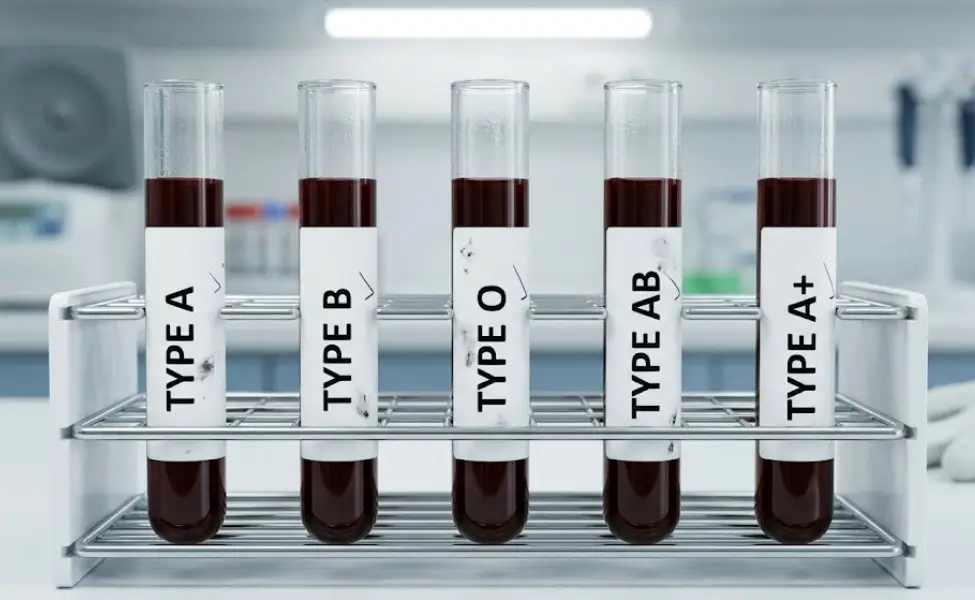
Japanese blood types show up everywhere once you start paying attention. Dating profiles, anime character bios, casual introductions, the occasional workplace icebreaker. Every time you notice it, the natural question is the same. Why does this matter?
Blood type in Japan functions as a personality shorthand, a simple way to make quick assumptions about someone before you know them properly. The system is called ketsueki-gata, which translates roughly as blood type personality theory. Knowing the basics will help you follow casual conversation, avoid misreading social moments, and answer confidently when asked which type you are.
The Closest Thing Japan Has to Star Signs
The easiest way to understand ketsueki-gata is to think of it as Japan’s version of Western astrology.
Both systems divide people into a small number of categories, and each one claims to explain why someone is organised, creative, stubborn, or difficult.
Neither has solid scientific backing, and plenty of people in both cultures use the labels casually without fully believing them.
Blood type carries a faint suggestion of biology because it is a real genetic fact, even if the personality claims are not.
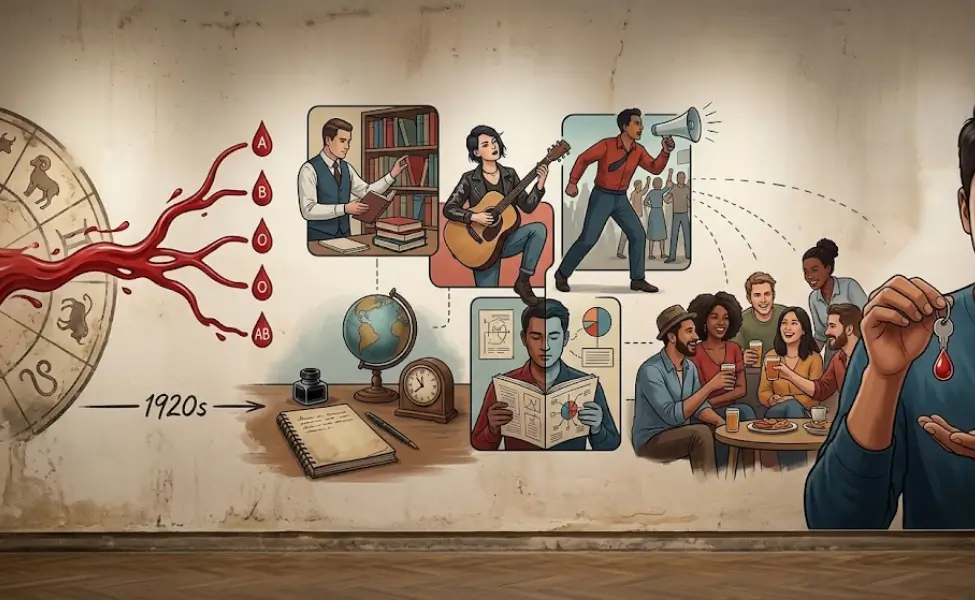
That combination of actual science and social myth gave the idea a staying power that purely invented systems rarely achieve.
It feels just plausible enough to repeat in conversation without embarrassment.
Far more Japanese people know their blood type than people in most Western countries.
A 2016 survey of 3,355 Japanese people found that 99% knew their type, a figure that reflects social expectation rather than medical necessity.
If you tell someone in Japan that you do not know yours, they will probably smile and move on. Knowing your answer does make the exchange a little smoother.
How a Journalist Made Blood Type a National Habit
The idea that blood type reflects personality first appeared in Japanese academic writing in the 1920s, when a psychologist named Takeji Furukawa published a paper claiming blood groups were linked to temperament.
His work attracted brief attention and sharp criticism from other academics, then largely faded from view.
The concept came back to life in 1971, when a journalist named Masahiko Nomi published a book called Understanding Affinity by Blood Type. Nomi had no scientific training in psychology or medicine.
He was an engineering graduate who became fascinated by the idea that blood type and personality might connect, and his book became a runaway bestseller.
Over the next decade, Nomi wrote more than ten follow-up titles, and after his death in 1981, his son Toshitaka continued the work.
By the 1980s and 1990s, blood type had appeared in magazine personality quizzes, TV variety shows, dating profiles, and occasional workplace conversations.
Anime and manga began listing characters’ blood types alongside height and birthday as standard biographical information.
The modern craze was not ancient tradition or deep spiritual belief.
It was a media phenomenon that took hold within living memory, driven by popular books and entertainment rather than by science or religion.
That framing stuck because it gives people a ready-made script for talking about personality without getting too personal too fast.
The Four Types and What People Say About Them
The stereotypes work because they are broad enough for almost anyone to find something recognisable in their category.
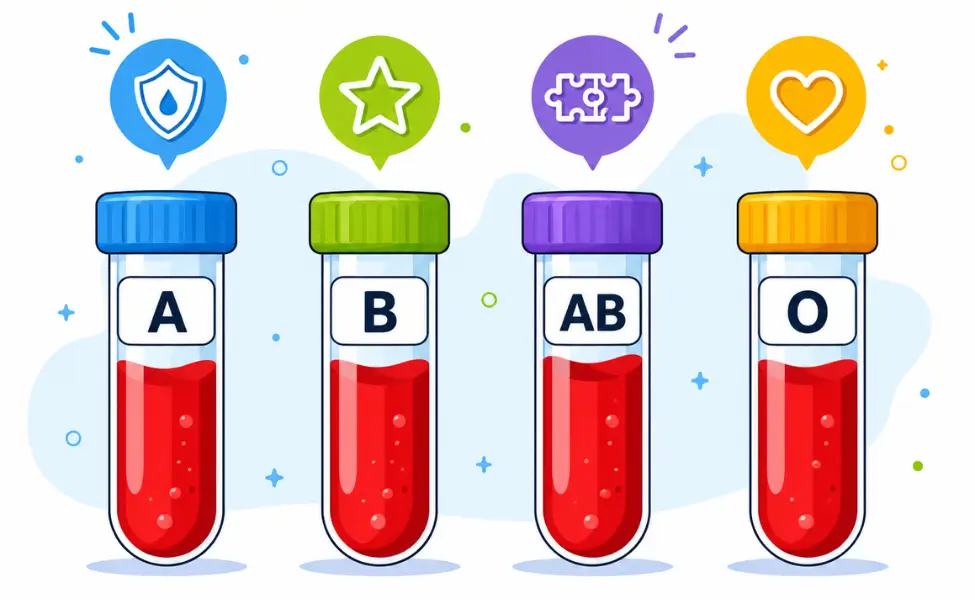
That feeling of recognition keeps the conversation going long after anyone has stopped taking the claims seriously.
Here is how Japanese people typically describe each type.
Type A (around 40% of Japan’s population)
- Organised, careful, and diligent
- Sensitive to social harmony and good at reading how others feel
- Responsible and reliable
- Can also be seen as anxious, stubborn, or perfectionistic
Type B (around 20% of Japan’s population)
- Passionate, creative, and very much their own person
- Cheerful and enthusiastic about their own interests
- Can be stereotyped as selfish, impulsive, or inconsistent
- Tends to receive the roughest treatment in blood type talk, especially in romantic contexts
Type O (around 30% of Japan’s population)
- Confident, outgoing, and practical
- Natural leadership energy and comfortable in social settings
- Can be seen as blunt, arrogant, or too laid-back
Type AB (around 10% of Japan’s population)
- Rational, adaptable, and difficult to read
- Seen as intellectual but also detached or unpredictable
- The mysterious label partly reflects that AB is the smallest group in Japan
These descriptions are flexible by design.
Personality generalisations stay in circulation because they feel plausible enough to repeat.
These descriptions are broad enough that most people find something recognisable in their category on any given day.
Where You Will Actually Encounter It
Blood type talk surfaces most naturally in situations where people are getting to know each other but are not yet close enough for deeper personal questions.
Introductions, first dates, group outings, and casual workplace chat all come up regularly.
Dating apps in Japan often include blood type as a profile field alongside age, height, and job.
Some users filter potential matches by type, using compatibility charts the way other apps use distance or shared interests.
Among friends, blood type jokes can run all evening, with people cheerfully blaming their type for being late, messy, or why a plan unravelled.
Anime characters have listed blood type alongside birthdays and hobbies as standard biographical data for decades.
Television variety shows run compatibility segments and personality quizzes based on blood type.
Even people who find the idea unconvincing still recognise the categories instantly.
Celebrity profiles include it as routine information.
Blood type talk does have a sharper edge worth knowing about.
The Japanese have a term, bura-hara, which stands for blood type harassment.
It describes situations where people use blood type to discriminate, whether in a job interview, a workplace decision, or a social judgement.
Type B individuals tend to get the hardest time.
Knowing that bura-hara exists helps explain why blood type talk does not always land as a light joke for everyone in the room.
How Seriously Do People Actually Take It
Most Japanese people hold blood type beliefs somewhere between a soft preference and a running joke.
Some enjoy the stereotypes, some find them tedious, and many use them simply because everyone already knows the script.
Very few treat it as a reliable system for understanding a real person.
From three decades of living in Japan, the pattern is consistent.
Blood type talk is strongest in casual social settings and weakens fast the moment real behaviour and real personality start to matter.
A first conversation might open with a blood type question, but a real friendship never depends on the answer.
Research backs up the scepticism.
A large-scale survey of more than 10,000 people across Japan and the United States found that blood type explained less than 0.3% of the total variation in personality.
Japanese psychologists have described it as sham science for years.
The popularity endures not because people are convinced by the evidence but because the social script is familiar, low-stakes, and easy to use.
What to Say When Someone Asks Your Blood Type
The most common anxiety for visitors is not the stereotypes themselves.
It is the moment someone in Japan asks which type you are and you freeze, unsure what kind of conversation you have just walked into.
You are almost certainly walking into a light social exchange.
The person wants something easy to talk about, a way to place you in a familiar framework without asking anything too personal.
Expect the same casual tone people use for star signs or hometowns, curious rather than serious or judgemental.
If you know your type, a simple answer and a return question keeps things moving.
Something like “I’m type O. What about you?” works perfectly.
If you do not know, a relaxed response like “I’m not sure, people outside Japan often don’t know theirs” usually gets a smile and moves the conversation along without any awkwardness.
What they are really checking is whether you will play along with a light social moment.
Warmth and willingness to engage matter far more than having a perfect answer ready.
Frequently Asked Questions about Japanese Blood Types
No. It’s not required for medical emergencies (hospitals will test your blood anyway), and socially, Japanese people know that foreigners usually don’t track this. It’s completely fine to just smile and say you don’t know.
It’s just a common social icebreaker. It functions exactly like asking “What’s your star sign?” in the West. It’s meant to be light small talk to keep a conversation moving, not a serious medical or psychological inquiry.
Type B often gets the most teasing. The stereotype is that Type B individuals are selfish or impulsive, to the point where there’s even a term for workplace discrimination based on it: bura-hara (blood type harassment). However, in casual social settings, it’s mostly just lighthearted banter.
Let me be straight with you.
No one is going to judge you if you don’t know your blood type.
It’s just a conversational tool and a low-stakes way for people to break the ice, fill an awkward silence, or share a laugh over a drink.
If you know your type, play along and have fun with it.
If you don’t, just smile and say you’re not sure.
Enjoy the small talk as a unique, everyday window into Japanese social life.
