

Most travel content about Kagoshima tells you to go without properly making the case.
I’ve tried to do something different in this article.
It lays out what Kagoshima genuinely delivers, where it falls short, and how it stacks up against the other destinations you are probably weighing.
The article also gives a clear view of what kind of traveller will find the journey worth making, and what kind will not.
The short answer is yes, with conditions.
Go if you are travelling for at least twelve days and have already given proper time to the main cities.
Hold off if your time in Japan is limited, or if this is your only trip for a while.
Your remaining days probably have a better use than a long journey south when key destinations remain unseen.
The journey here is real, and that matters when you are planning around finite annual leave.
What Spending Two Days in Kagoshima Actually Feels Like
Kagoshima has a texture that sets it apart from other southern Japanese cities, and the difference is not subtle once you are there.
Three things do most of the work in defining it.
The Volcano Is Not a Backdrop
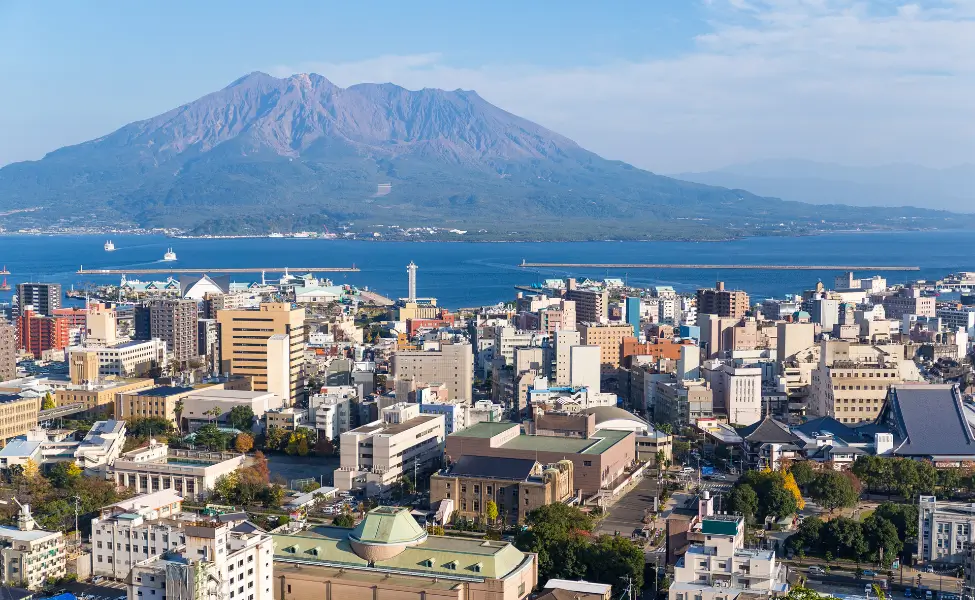
Sakurajima sits roughly four kilometres across the bay from the city centre and erupts regularly, sometimes every day.

On active days the city receives a light dusting of volcanic ash, and locals carry umbrellas for it the same way people elsewhere carry them for rain.
The mountain is visible from the waterfront, from restaurant windows, from the tram, and from your hotel room if it faces the right way.
You cannot visit Kagoshima and treat the volcano as a side trip. It is the context for everything else.
There is a specific mood the place produces in the evening, standing at the waterfront as a plume of smoke drifts across darkening water.
It is not comfortable or reassuring in the way that beautiful coastal cities tend to be.
Kagoshima feels like a city that has accepted its situation, rather than one that has resolved it.
History That Has Not Been Processed for Tourists
The Shimazu clan governed this region for around 700 years.
Their presence runs through the city in a way that does not feel performative.
Sengan-en garden, built in 1658 as a Shimazu residence, uses the bay and Sakurajima as its borrowed landscape.
The garden still occupies its original position, and the Shimazu family’s descendants manage it today.
More arresting is Shiroyama hill, which rises above the city centre. The Battle of Shiroyama took place there on 24 September 1877.
Saigo Takamori and around 500 samurai held the hill against 30,000 Imperial troops in the final engagement of the Satsuma Rebellion.
He died on that hillside as the samurai era ended.
From the top, looking down at the city, you are barely 150 years from that fight.
That proximity to unsettled history gives Kagoshima a gravity that polished heritage destinations rarely match.
The Food Has a Clear Regional Identity
Few Japanese cities outside the main centres have a food culture this specific.
Kurobuta pork comes from a local Berkshire strain and appears throughout the city in tonkatsu, hot pot, and grilled skewers.

Vendors sell satsuma age fish cakes as casual street food.
Sweet potato shochu is the local drink, and Kagoshima produces more of it than anywhere else in Japan.
Eating here produces the specific satisfaction of a place that feeds you from its own landscape rather than from a general idea of Japanese cuisine.
How Kagoshima Compares to the Alternatives
This is where the verdict gets more useful, because Kagoshima does not win every comparison.
Kagoshima vs Nagasaki
Nagasaki is a stronger choice if your primary interest is history with international weight.

The atomic bomb sites, the Dutch trading post, and centuries of hidden Christian communities give Nagasaki a story that reaches a wider range of visitors.
It also sits closer to Fukuoka and is far easier to reach as a two-day extension from the main Kyushu rail corridor.
Kagoshima wins on natural drama and genuine distinctiveness.
Nagasaki is moving and worthwhile, but you can situate it within things you already know.
Kagoshima is harder to place, and the experience of being there is not quite like anything else in Japan.
Kagoshima vs Beppu
Beppu is the clearer choice if hot springs are your primary reason for going south in Kyushu.

It sits on the main rail line, is quicker to reach from most parts of the island, and delivers a more concentrated onsen experience.
If you have one day to give to thermal bathing, Beppu is the more efficient argument.
Kagoshima offers more breadth.
The sand baths at Ibusuki are a different kind of thermal experience from Beppu’s onsen, the volcano adds a dimension Beppu cannot match, and the historical depth creates a more complete stay overall.
Kagoshima vs Staying Longer in the Main Cities
This is perhaps the most honest comparison to make.
A first-time visitor to Japan with ten days or fewer has strong grounds for giving that time entirely to Tokyo, Kyoto, and Osaka.
Those cities are not overrated, and most visitors leave before properly exploring them.
For most first-time visitors, Kagoshima works better as a second-trip destination.
A longer first trip of fourteen or more days can absorb it once the main cities have been properly covered.
What Kagoshima Does Not Do Well
Understanding the weaknesses matters, because certain travellers will find this destination underwhelming no matter how enthusiastically others recommend it.
The city is not a strong choice for visitors whose primary interest is urban food energy.
Fukuoka has a far denser restaurant scene, better ramen, more street food options, and a late-night eating culture that Kagoshima does not match.
The local food here is distinctive but narrow, and you eat well within a limited repertoire.
Kagoshima is also not a meaningful destination for travellers focused on traditional Buddhist and Zen culture.
There are no landmark temples, no iconic shrine complexes, and no equivalent of the cultural layering you find in Kyoto or Nara.
The culture here is samurai, volcanic, and southern, which is exactly the right answer for some visitors and entirely the wrong one for others.
The journey itself is a real cost, not a dismissible one.
Flying from Tokyo takes just under two hours, and the Shinkansen via Fukuoka takes just over six.
Neither option is unreasonable, but both demand real planning and consume a meaningful slice of available travel days.
For some itineraries, that cost is worth it.
Other trips simply cannot absorb it.
Finally, the city works well without a car, but the wider prefecture rewards having one considerably.
Visitors relying on public transport will manage a solid two to three days in the city and at Ibusuki.
The Kirishima volcanic highlands, the southern peninsula, and some of the region’s more remote onsen towns all become far more accessible with your own transport.

This is a practical limitation worth knowing before you arrive.
The Experiences That Justify the Journey
For the traveller who fits the profile above, four things make the trip earn its place.
Sakurajima
The municipal ferry crosses from Kagoshima Port every 15 to 20 minutes and costs 250 yen per adult.
Each crossing takes about 15 minutes.
A sightseeing bus runs a regular loop from the ferry terminal to the main viewing points, so no car is required.
Half a day covers the island properly.
When you stand there and see the lava fields, the coast, and the city across the water, it feels more impressive than photos make it look.
It really does live up to the hype once you are there.
Sengan-en and Shiroyama
These two places are easy to combine in half a day.
Sengan-en gives you the Shimazu family at the height of their power.
The 50,000 square metre garden faces the volcano across the bay, and inside you will find a well-preserved residence, a museum covering the family’s role in Japan’s industrialisation, and a glass workshop producing traditional Satsuma Kiriko glassware.
Both the garden and the museum carry UNESCO World Heritage status.
Shiroyama marks where their era ended, and with it the samurai era as a whole.
The walk up takes ten minutes.
Views over the city are clear and unobstructed.
The place feels genuinely significant when you are there.
The City View sightseeing bus reaches both sites from the city centre.
Ibusuki
Ibusuki is 50 minutes south by limited express train and requires no car.
The main sand bath facility is a short walk from the station.
Staff bury you to the neck in naturally heated volcanic sand at around 50 to 55 degrees Celsius.
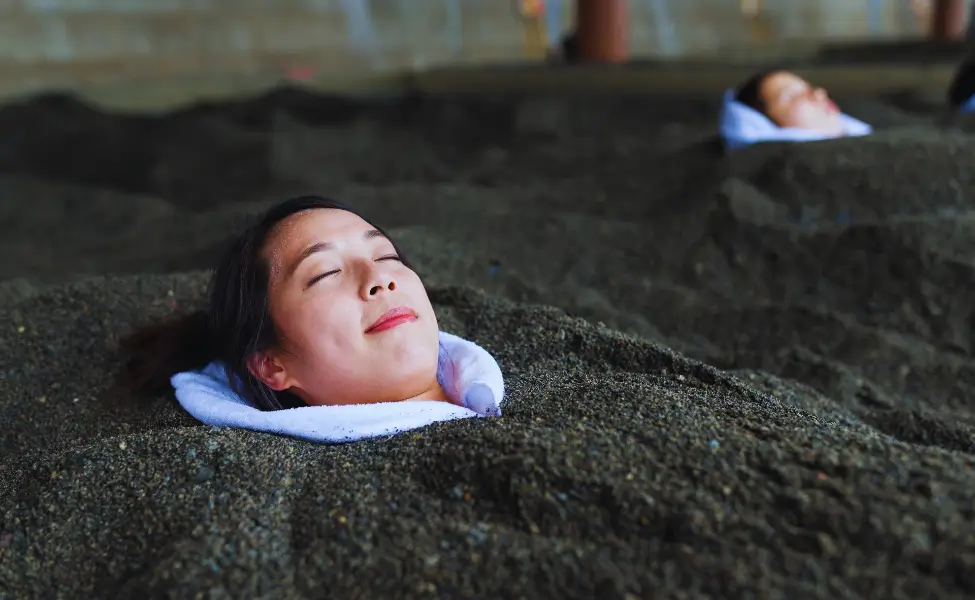
Sessions last 10 to 15 minutes and lead directly into regular hot spring baths.
It feels a bit strange and not always comfortable, but you will probably remember it more than a lot of other things you do in Japan.
More than most activities, this is the kind of thing you will talk about afterwards.
Who Should Go and Who Should Not Bother
Book Kagoshima if you are travelling for twelve or more days and have already given proper time to the main cities.
The stop works best for travellers who want somewhere genuinely unlike the rest of the itinerary.
It suits people who like dramatic scenery, real samurai history, and food that feels tied to the place.
Skip it if your time in Japan is limited, or if you have not yet properly explored the main cities.
Travellers whose primary interests are temple culture, dense urban food scenes, or comfortable day trips from a single base will find the journey south hard to justify.
The minimum worthwhile version is two full days.
A morning on Sakurajima, an afternoon between Sengan-en and Shiroyama, and one evening eating well in the city makes the case for the stop.
Add the Ibusuki day trip on a third day if the schedule allows, and stay near Kagoshima Chuo Station for easy access to all of it.
That kind of trip is enough to show whether Kagoshima is worth it for you.
For the right person, Kagoshima is worth the effort of getting there.
