
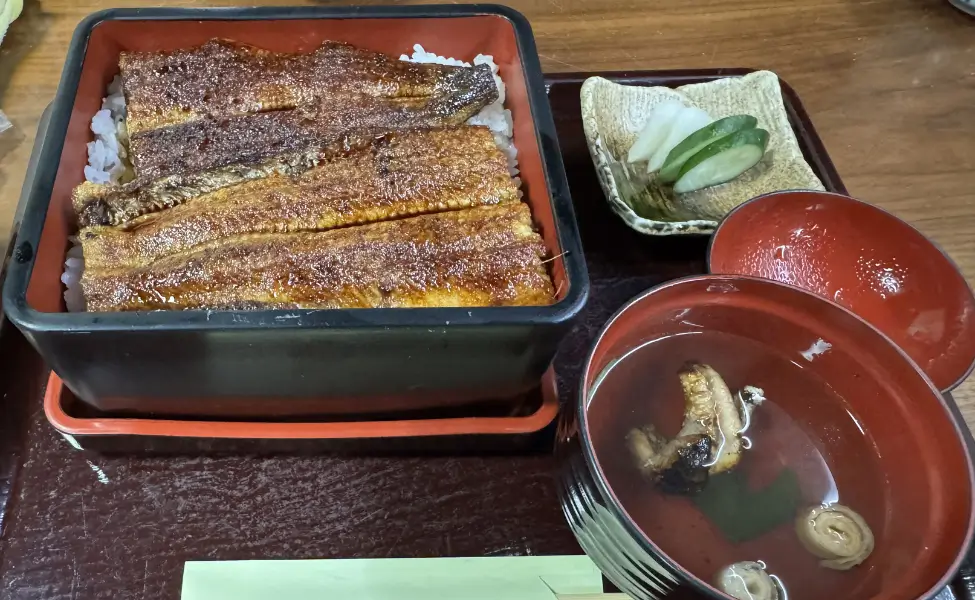
Hitsumabushi is arguabaly Nagoya’s most famous dish. Grilled eel over rice. You don’t eat it straight through like an ordinary meal, though.
Divide the bowl into four portions and eat three different ways. Save the last portion for whichever way you liked best.
Getting the method right is what makes hitsumabushi worth the extra cost over a regular eel bowl. Nagoya chefs also grill the eel without steaming it, unlike Tokyo, giving firmer texture and crisper skin.
Quick answer
- Order it by name, ひつまぶし (hitsumabushi), even if the English menu calls it eel over rice or grilled eel rice bowl.
- Divide the bowl into four portions with the rice paddle provided.
- Eat the first plain, the second with the condiments, the third with dashi broth poured over it, and the fourth however you liked best.
- Expect to pay roughly 3,000 to 5,000 yen for a standard portion, with larger versions costing more.
- Atsuta Horaiken Honten is walk-in only for a regular meal; Shirakawa lets you join an online queue or book ahead.
Ordering it and what comes to the table
The word to use when ordering is ひつまぶし(hitsumabushi), and a phone screenshot of it is usually enough even with no Japanese.
If you want a full sentence, ひつまぶしを一つお願いします (hitsumabushi o hitotsu onegaishimasu) means “one hitsumabushi, please.”
If you’ve booked online , 予約しています (yoyaku shiteimasu), meaning “I have a reservation,” is useful alongside your name.

Your meal arrives in a wooden or lacquered box called an ohitsu. Rice comes topped with grilled eel in sweet soy-mirin sauce, plus condiments (green onion, wasabi, shredded nori), pickles, soup, and a pot of dashi for later.
Most restaurants make dashi from fish, so ask staff about allergies instead of trusting the menu photo.
Eating it the Nagoya way
- Split the bowl into four roughly equal portions with the rice paddle, cutting a cross through the rice so the eel divides evenly too.
- Serve the first portion into your small bowl and eat it plain, with no condiments, so you can taste the eel and the sauce on their own.
- Serve the second portion and mix in the condiments to taste. Go easy on the wasabi to start with, since some restaurants serve it stronger than you might expect.
- Serve the third portion and pour the dashi over it until the rice is loosened but not swimming, then eat it ochazuke-style.
- Serve the last portion and eat it however you enjoyed the meal most, plain, with condiments, or with more broth.
Choosing a restaurant
Nagoya has plenty of hitsumabushi restaurants, but two are worth knowing well because they represent genuinely different experiences, one traditional and walk-in only, the other much easier to plan around.
Prices, opening hours and reservation systems can change, so it’s worth checking each restaurant’s official website before you go.
Of course you don’t need to go to the ones in this article.
I tend to prefer the local ones dotted around town, often obvious as they have smoke from cooking poring out of them.
Atsuta Horaiken Honten
Atsuta Horaiken is one of two restaurants credited with inventing hitsumabushi, and it holds the trademark on the name. Which came first is still disputed.
The Honten branch sits at 503 Godo-cho, Atsuta-ku, seven minutes on foot from Atsuta-jingu-denmacho Station. Stop by if you’re already visiting Atsuta Shrine.

It’s open 11:30am to 2pm and 4:30pm to 8:30pm, closed Wednesdays and the second and fourth Thursday of the month. Hitsumabushi is 4,950 yen, with a larger “ichihan” portion at 6,600 yen.
Honten doesn’t take reservations for a regular meal. You register your name and party size at the door and wait to be called. You register your name and party size at the door and wait to be called, and visitors commonly report around a two-hour wait at weekend lunch.
Arriving right at opening, or choosing an early or late weekday sitting, is the most reliable way to cut that down. If the queue looks unmanageable, Atsuta Horaiken has two other sit-down branches, Jingu-ten, a few minutes away, and Matsuzakaya-ten near Yaba-cho Station.
Shirakawa, in Sakae or Joushin
Shirakawa runs four sit-down restaurants across Nagoya.
Joushin Honten is in Nishi-ku, two to three minutes from Joshin Station in a quieter part of the city. The Sakae Gas Building branch stands in central Sakae, about two minutes from Yaba-cho Station.
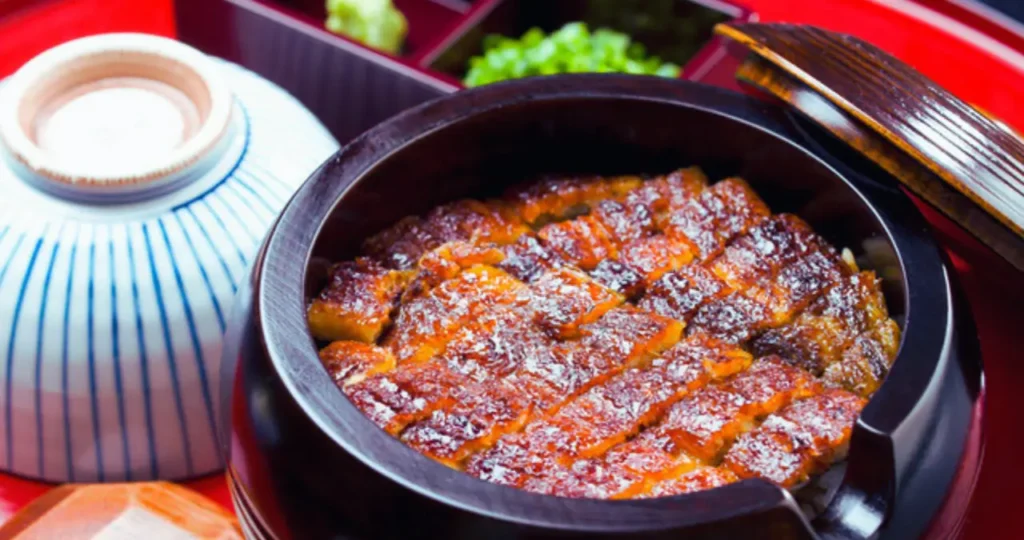
Choose Joushin Honten for a slower, more local afternoon. Pick the Sakae branch between shopping trips or before an evening out.
Joushin Honten opens roughly 11am to 2:30pm and 5pm to 9:30pm on weekdays, with later weekend lunch service. It closes Thursdays. The Sakae branch serves lunch slightly later, around 11:30am to 3pm, and keeps the same evening and weekend hours. It also closes Thursdays.
Unlike Atsuta Horaiken, Shirakawa lets you join a same-day queue online or book ahead, removing much of the uncertainty. Still, reserve before a busy lunch.
Hitsumabushi costs 3,100 yen for the standard size and up to 5,600 yen for the largest, at either branch.
Avoiding queues and reservation mistakes
Weekends, public holidays and peak travel periods bring the biggest crowds, so weekday lunches are usually quieter.
A reservation does not always mean you can sit down straight away.
Some restaurants still call guests in arrival order, even when they have bookings.
Leave some extra time around your meal, especially during busy periods.
Is it worth the price
Hitsumabushi costs more than a typical casual lunch, so it suits people who really enjoy eel.
You get to enjoy the same dish three different ways, which helps justify the higher price.
Take your time with the meal instead of squeezing it between timed attractions.
For a cheaper option, try Hitsumabushi Inou near Nagoya Station in the Esca underground mall.
Prices start at around 2,760 yen.
Shirakawa also has a takeaway counter in the basement of JR Nagoya Takashimaya.
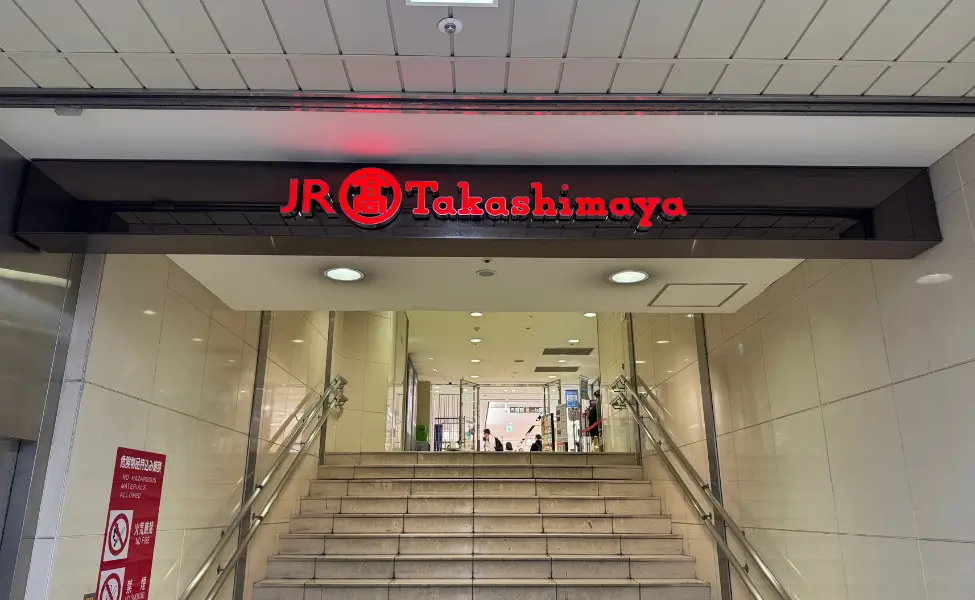
You can take it back to your hotel or eat it on the move.
