

If every Japan itinerary you find sends you to the same five places, you are not imagining it.
Tokyo, Kyoto, Osaka, Nara, and possibly Hiroshima dominate travel content because they are easy to research, easy to photograph, and easy to write about.
They are also places where, on a busy day, you may queue for twenty minutes to take a photo in front of something you have already seen thousands of times on social media.
That is not a failure of the destinations themselves.
It is a failure of travel information, and the result is that a large portion of Japan goes almost entirely unvisited by people who would absolutely love it.
Akita Prefecture sits in the Tohoku region of northern Honshu, and it consistently fails to appear on the itineraries of Western travellers, even those who have been to Japan more than once.
It has a centuries-old samurai district, a UNESCO World Heritage wilderness, and a summer festival with no equivalent elsewhere in the country.
The mountain hot springs are among the most atmospheric in Japan.
Tourist traffic is a fraction of what flows through Kyoto and Nara.
That combination is not an accident.
Akita is simply underserved by English-language travel content, and that absence makes it appear harder to visit than it actually is.
This is a practical article covering what you need to plan a real trip to Akita.
It addresses transport, timing, and the experiences worth organising your whole visit around.
Getting to Akita from Tokyo
Akita is straightforward to reach from Tokyo, with two practical options for most international travellers.
| Option | Route | Journey Time | Notes |
| Komachi Shinkansen | Tokyo Station to Akita Station via Morioka | Approx. 3 hours 45 minutes to 4 hours | Covered by the JR Pass. All seats reserved. The train couples with the Hayabusa as far as Morioka, then continues independently on standard-gauge tracks. This slower final leg passes through mountain scenery worth watching. |
| Flight | Tokyo Haneda to Akita Airport (AXT) | Approx. 1 hour 5 minutes | ANA and JAL both operate this route. The airport connects to the city by bus or taxi. Faster than the train but requires airport transfers at both ends. |
| Car | Tokyo to Akita via the Tohoku Expressway | Approx. 7 hours | Not recommended as the primary way in from Tokyo. A rental car is far more useful once you are already in Akita, particularly for reaching rural areas between attractions. |
The Shinkansen is the most practical choice for most travellers.
It also stops at Tazawako and Kakunodate, two of Akita’s best destinations.
This means you can combine your arrival with your first day of sightseeing.
Car rental is available at Akita Station, and an International Driving Permit is required to drive in Japan.
Akita City: The Logical Base
Akita City is the prefectural capital and the most practical base.
It is a working city rather than a curated tourist destination, and that distinction matters.
Walking through Akita City has a grounded, ordinary quality that the most-visited parts of Japan rarely offer any more.
Senshu Park and Kubota Castle
The ruins of Kubota Castle occupy the centre of Senshu Park.
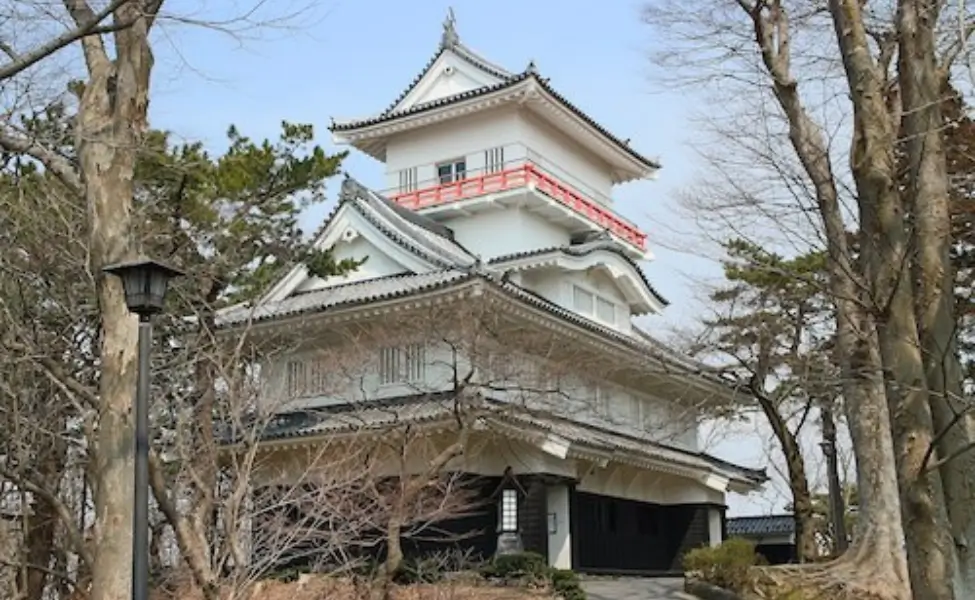
Built in 1604 by the Satake clan, the castle became the seat of the Kubota Domain and remained so throughout the Edo period.
A fire in 1880 destroyed most of the remaining structures.
What stands now is a reconstructed turret and main gate, set within a park that fills with cherry blossoms in late April.
The reconstruction is honest rather than decorative.
This is a ruin with historical context rather than a replica built for spectacle.
The park around it is genuinely pleasant as a place to walk, and the Akita Museum of Art stands at its edge, housing works by Tsuguharu Foujita alongside a collection with a strong regional focus.
Akita Port Tower Selion
The Port Tower Selion is a 143-metre glass tower at Akita Port, completed in 1994. Its observation deck sits at 100 metres and admission is free.

The view takes in the city, the Sea of Japan, the Oga Peninsula, and Mount Chokai on clear days.
It is worth an hour of your time and costs nothing.
That combination makes it a reliable first stop when you want to orient yourself to the geography of the prefecture.
The ground floor of the complex has a small market selling local produce and Akita specialities.
An udon vending machine in the adjacent building is, by all accounts, worth experiencing.
It is a relic of a Japan that rarely exists anymore, and it still works.
Kakunodate, Lake Tazawa, and the Mountains
These three destinations form the core of any Akita trip outside the city, and two of them are accessible directly by Shinkansen.
Kakunodate
Kakunodate is a former samurai town with several streets of preserved Edo-period residences. A number of them are open to the public without booking.

Walking through the Bukeyashiki district does not require a tour or any advance preparation.
The residences are not museum pieces in the staged sense.
They are old buildings in a functioning town.
The contrast between the preserved district and the ordinary streets surrounding it gives the place an authenticity that polished tourist sites rarely manage.
The town sits on the Akita Shinkansen line.

You can step off the bullet train and be walking the samurai streets within ten minutes.
That makes Kakunodate an easy addition to the journey from Tokyo or back down.
Lake Tazawa
Lake Tazawa is a near-perfect circle of water in the mountains east of Akita City.
At 423 metres deep, it is the deepest lake in Japan.
The depth accounts for its colour, which shifts between jade green and deep indigo depending on the light and the season.

Even in January, the lake never freezes, which gives it an unusual quality in the middle of a northern Japanese winter.
A sightseeing boat runs between late April and early November.
It connects the eastern shore to the Tatsuko Statue, a golden figure from local legend.
Cycling around the lake takes two to three hours.
The surrounding area has several onsen, and Nyuto Onsen is worth discussing in its own right.
Nyuto Onsen
Nyuto Onsen is a cluster of traditional hot spring inns set in a mountain valley about 40 minutes by bus from Tazawako Station.
It is the kind of place that makes the case for onsen travel in a way that a generic hotel hot spring cannot.

The water quality varies between inns, from milky white to a rust-coloured iron spring.
What you get is forest, silence, and steam rather than resort and lobby.
Several of the inns have outdoor baths beside streams or forest paths.
These places are not designed specifically for foreign visitors, but they are not unwelcoming.
Arriving at one after a day of hiking or travel is an experience difficult to replicate elsewhere in Japan.
Booking ahead is essential, particularly for weekends and the autumn foliage season in October.
The Shirakami Mountains
The Shirakami Mountains straddle the border between Akita and Aomori Prefectures.
They hold the largest remaining primary beech forest in East Asia and have been a UNESCO World Heritage Site since 1993.
Steep terrain and a limited trail network mean the core zone requires a permit to enter.

The accessible hiking around Anmon Falls and the Juniko lake area requires no special permits.
It offers a level of solitude that has become genuinely rare in Japan’s more popular national parks.
Wildlife in the area includes the Japanese serow, Asiatic black bears, Japanese macaques, and golden eagles.
The Anmon Falls trail takes around 90 minutes return and suits walkers of average fitness.
Come prepared with solid footwear and water. If you visit between July and September, the trail will be busier, mostly with Japanese walkers rather than foreign tourists.
Odate City, in the northern part of the prefecture near the Shirakami area, is the original home of the Akita Inu.
The Akita Inu Hometown Museum in Odate lets you meet the dogs up close.
If you are already heading into this part of the prefecture, it is worth adding to the itinerary.
The Festivals Worth Timing Your Trip Around
Akita has three festivals that represent a level of cultural specificity you will not find along the Golden Route.
Kanto Festival (August 3 to 6)
The Kanto Festival takes place in Akita City each year from August 3 to 6.
It is one of the three great festivals of the Tohoku region.
The central performance involves men balancing bamboo poles hung with lit paper lanterns, held on their palms, shoulders, foreheads, and lower backs.
At their largest, these poles stand twelve metres high, carry 46 lanterns, and weigh up to 50 kilograms.

Learning to balance one is a skill passed down through generations, and the physical control involved is more impressive in person than photographs suggest.
Night performances run along Kanto Odori street from around 7.15 p.m. on each of the four evenings, lasting around 90 minutes.
Each evening ends with a participation session where audience members can try holding a kanto and speak with the performers.
Daytime skill competitions run from August 4 to 6. Paid reserved seating is available but not essential.
The street is nearly a kilometre long and good vantage points exist along its whole length.
Hotels in Akita City book out weeks in advance for this period. Plan accordingly.
Kamakura Festival (February 15 and 16)
The Kamakura Festival takes place in Yokote City, in the southeastern corner of Akita Prefecture, on the evenings of February 15 and 16.
Local people build kamakura, which are igloo-like snow huts, at locations across the city. Inside each one, children sit beside a small altar dedicated to the water deity and invite passers-by inside.
They offer amazake, a warm, low-alcohol sweet rice drink, along with grilled rice cakes.
The atmosphere inside a kamakura is genuinely unlike anything else.
It is candlelit and warm, with the sounds of the city outside muffled by snow.
The walk between huts along streets illuminated by the candle glow of the miniature kamakura is worth the trip alone.
Yokote is accessible from Omagari Station by a short local train.
Namahage
The traditional Namahage custom takes place on New Year’s Eve on the Oga Peninsula.
Going from house to house, young men dressed as fearsome demon figures in straw capes and horned masks challenge children about their behaviour.

This is a private community ritual rather than a tourist event.
For visitors, the accessible version is the Namahage Sedo Festival, held over a weekend in mid-February at Shinzan Shrine in Oga City.
It combines fire rituals and performances with the Namahage tradition.
The Namahage Museum in Oga City provides context on the history and regional variation of the custom.
It is worth a visit for the displays of masks and costumes alone.
Oga City is around 50 minutes by train from Akita Station on the JR Oga Line.
What You Will Eat in Akita
Akita has a regional food culture specific enough to be worth actively seeking out. You are unlikely to encounter most of it elsewhere in Japan.
Kiritanpo starts with freshly cooked rice, mashed and pressed onto cedar skewers, then grilled over charcoal.

This gives the outside a light crust while the inside stays dense and slightly chewy.
Traditionally, it arrives as part of a hot pot.
The broth draws on Hinai chicken, the local free-range breed prized for its flavour, along with burdock root, leeks, and maitake mushrooms.
This is one of those regional dishes that does not travel well.
Eat it here, in a small restaurant, ideally when it is cold outside.
Inaniwa Udon is a hand-stretched noodle with centuries of history in Akita.
It is thinner and silkier than most Japanese noodles.
In summer it comes cold with a light dipping sauce, and in winter it arrives in a simple broth.
You will find it across the prefecture in restaurants that have been making it the same way for generations.
Akita is a significant sake-producing region.
Local brewers draw on high-quality locally grown rice and the cold, pure water from the Ou Mountain range.
Several breweries accept visitors and offer tastings.
Akita sake tends toward a clean, lightly sweet style that pairs well with the prefecture’s fish and rice dishes.
The local fish, hatahata or sailfin sandfish, is an Akita speciality associated with winter, often salted, fermented, or used in hot pots.
Magewappa lacquerware, made by bending thin strips of cedar into rounded containers, is the souvenir most worth bringing home.
Items to look for include:
- Bento boxes and rice containers
- Lacquered bowls
- Sake cups
- Small trays
Quality pieces are not cheap, but they are practical, durable, and made in the region.
Planning Your Trip: Days, Transport, and Language
A meaningful trip to Akita takes at least five days, and a week is more comfortable.
Three days is enough to scratch the surface. You will leave with a list of things you did not get to.

A workable framework is two days based in Akita City, with a day trip to the Oga Peninsula included.
Follow that with a day in Kakunodate and a night at Nyuto Onsen.
That covers the main ground in five days, with the Shirakami Mountains as a sixth if you have the time.
Anyone with more time can extend into Aomori and Yamagata, which both connect well by train.
Together they form a natural Tohoku loop that uses Akita as an anchor.
Transport
Public transport covers the main attractions adequately if you are based in Akita City and using the Shinkansen to reach Kakunodate and Tazawako.
For the Oga Peninsula, the Shirakami area, and anything off the main lines, a rental car makes a significant difference.
Car rental is available at Akita Station.
Roads in rural Akita are generally well-maintained and clearly signed.
Driving in the region is far less stressful than navigating a major city.
Language
Language is worth addressing directly, because it is the objection that makes people put Akita in the “next time” category.
English signage is limited outside the main tourist sites, and staff at smaller ryokan and restaurants may not speak it.
This is manageable.
Most accommodation can be booked online in English.
Translation apps handle menus and road signs well enough for daily navigation.
The goodwill shown to visitors who make the effort to turn up is consistent and genuine.
Many travellers who have taken this kind of trip report the same thing.
The absence of tourist infrastructure becomes part of the experience rather than an obstacle.
Best Time
The best time to visit depends on what you are after.
August brings the Kanto Festival and warm weather with hiking at its best.
October brings the foliage season, which peaks in the mountains from mid-October and arrives with fewer crowds than autumn in Kyoto.
February brings both the Kamakura Festival in Yokote and the Namahage Sedo Festival.
The winter months also offer the most atmospheric onsen conditions.
Akita has heavy snowfall between December and March, so come prepared.
