

Gunma Prefecture sits two hours from Tokyo by train.
Most people skip it and spend those two nights somewhere on the standard circuit instead, queuing for the same spots, photographing the same views.
This article makes a case for not doing that.
Kusatsu Onsen, the centrepiece of any Gunma trip, has topped Japan’s national hot spring rankings for over 22 consecutive years.
Tomioka’s UNESCO World Heritage site tells a chapter of Japanese industrial history that most tourists never reach.
Minakami offers white-water rafting, serious mountain hiking, and some of the country’s most talked-about riverside outdoor baths.
The contrast with the rest of a standard Japan trip is not the selling point of Gunma.
It is the point.

When to Choose Gunma Over Hakone (and When Not To)
Here is the honest version.
Hakone is the better choice if your Japan trip runs fewer than seven days, if you are combining Tokyo with Kyoto and need a night between them, or if seeing Mount Fuji is a genuine priority.
The transport is simpler, the tourist infrastructure is more developed for overseas visitors, and nothing about Hakone requires much planning.
Gunma is the better choice if you have already done Hakone, if you want a proper onsen town rather than a resort hotel with a hot spring bath, or if the idea of spending two nights somewhere where foreign tourists are genuinely rare appeals to you.
The quality of the water in Kusatsu is better than anything you will find in Hakone.
The outdoor experience in Minakami is harder, wilder, and more varied.
The transfer logistics take a little more thought, but nothing about getting around Gunma is actually difficult.
The case for Gunma over Kawaguchiko is simpler.
Kawaguchiko is a Mount Fuji viewing base.
Gunma is a destination.
If seeing Mount Fuji from a lake is what you came for, Kawaguchiko wins easily.

If you want onsen, mountains, history, and outdoor activity, Kawaguchiko cannot compete.
The real reason most people do not visit Gunma is not that it is hard to reach or lacking in things to do.
It is that nobody told them it was worth considering. Hopefully this helps.
Getting to Gunma from Tokyo
The main entry points are Takasaki and Jomo-Kogen, both served by the Joetsu Shinkansen from Tokyo Station.
In practice, most travellers heading to Kusatsu will follow the same first leg regardless of where they go next.
Joetsu Shinkansen to Takasaki, then a series of connections onward.
| Destination | Route | Approximate journey time | Notes |
| Kusatsu Onsen | Tokyo → Takasaki (Shinkansen, 50 min) → Naganohara-Kusatsuguchi (JR local, 50 min) → Kusatsu bus terminal (bus, 25 min) | Around 2.5 hours | Bus not covered by JR passes. Buses run roughly every 1 to 2 hours from the station. |
| Minakami | Tokyo → Jomo-Kogen (Shinkansen, 70 min) → Minakami by bus (25 min) | Under 2 hours | Takaragawa Onsen requires a further 35 min bus from Minakami, only 4 to 5 services daily |
| Tomioka Silk Mill | Tokyo → Takasaki (Shinkansen, 50 min) → Joshu-Tomioka (Joshin Dentetsu, 35 min) → 10 min walk | Around 1 hr 45 min | Joshin Dentetsu not covered by JR Pass, runs twice an hour |
The one thing worth knowing before you travel:
Naganohara-Kusatsuguchi, the station before the bus to Kusatsu, has limited facilities and minimal English signage.
If you miss a bus connection there, the next one can be an hour away.
Check the timetable in advance, build a buffer into your arrival, and the journey is straightforward.
Ignore this and you may spend an unplanned hour on a quiet platform in rural Gunma wondering why nobody warned you.
A day trip to Kusatsu from Tokyo is possible.
An overnight stay, arriving by early afternoon and leaving after a morning bath, is considerably better.
The difference is not subtle in the way that most travel articles use the phrase. Kusatsu genuinely changes once the day visitors leave.
Kusatsu Onsen: Japan’s Top-Ranked Hot Spring Town
Arriving in Kusatsu, the first thing you notice is the smell.
Sulphur reaches you before the town comes into view, carried down the mountain road at 1,200 metres.

By the time you reach Yubatake, the hot water field at the town’s centre, the reason for Kusatsu’s reputation becomes immediately obvious.
Steam rises through a network of wooden channels that feed bathhouses and ryokan throughout the town, and the whole arrangement has been here in one form or another for centuries.
Japan’s Top 100 Hot Springs survey has ranked Kusatsu first for over 22 consecutive years.
This is not a case of clever marketing. It reflects the repeated preferences of Japanese travellers who have bathed in enough onsen to compare them properly, and who keep choosing Kusatsu.
How long to stay
One night is the minimum that makes the journey worthwhile.
Two nights makes sense if you want to explore the mountain road above town or take a day trip to Onioshidashi Volcanic Park.

For most travellers passing through as part of a longer trip, one night is enough.
Several things about Kusatsu are worth knowing before you visit.
- The hot spring water is strongly acidic and can feel sharp on sensitive skin. This is normal and part of what makes the water effective.
- Public bathing is available at several bathhouses around town at no charge or for a small fee. Staying at a ryokan gives access to private and shared baths throughout your stay.
- Kusatsu runs a ski resort from late December through to late March. Combining a morning on the slopes with an evening in the baths makes for a genuinely unusual winter trip.
- The town has enough restaurants, cafes, and shops to fill an evening and a morning comfortably without needing a car.
- English is spoken at most ryokan and tourist-facing businesses, but menus and some signage outside the main tourist zone are often Japanese only.
The yumomi experience is unique to Kusatsu.
Performers stir the hot spring water using long wooden paddles to lower its temperature without diluting the mineral content, a technique developed here during the Edo period.
Demonstrations run six times daily at the Netsunoyu facility for a few hundred yen.
Most visitors find it more engaging than they expected.
If you only do one thing in Kusatsu, do this: walk to Sainokawara Park after dark and get in the outdoor bath.
Everything else in Kusatsu is worth doing, but the evening outdoor bath is the reason people come back.
Sainokawara Park and the outdoor bath
Sainokawara Park sits at the western edge of Kusatsu town, about ten minutes on foot from Yubatake.

Hot spring streams run through the park alongside rock formations and seasonal foliage, and free foot soaking areas let you warm your feet in the mineral water at no charge.
A large open-air bath at the far end costs around 600 yen for full immersion.
Going after dark is the right call.
The steam rises visibly against the night sky, the temperature contrast between the cold air and the hot water is pronounced, and the park is quiet in a way that the town itself rarely is during the day.
Skip if short on time: the Kusatsu Onsen Tourism Information Centre and the souvenir shopping district.
A note on Mount Shirane
Mount Shirane, an active volcano above Kusatsu, has had visitor restrictions in place since a phreatic eruption in January 2018 that caused one fatality.
In August 2025, the Japan Meteorological Agency raised the alert level to Level 2, recommending that people avoid approaching the crater area.
Check the current JMA alert before planning any activity near the summit.
The mountain road drive, accessible from around mid-April to mid-November, offers views of the volcanic landscape from a safe distance.
Minakami: Activities, Onsen, and the Tanigawa Mountains
Where Kusatsu is compact and built around the act of bathing, Minakami earns its reputation through what is outside.
The Tanigawa range rises to nearly 2,000 metres above the valley floor and dominates the view from town in a way that changes how the place feels.

Standing beside the Tone River on an October morning, watching the upper ridgelines in colour while the water below is still warm enough to kayak, is the experience that most Minakami visitors describe when asked what the place is actually like.
No queue or tour group narration.
Just a cold morning and a fast river and the mountains doing what mountains do in autumn.
Minakami’s activities shift substantially with the seasons.
- Spring and summer (April to October): White-water rafting on the Tone River, canyoning, bungee jumping, and kayaking. Rafting trips cost around 5,000 to 8,000 yen per person and operators in town handle bookings without requiring much advance planning.
- Autumn (October to November): The Tanigawa range turns in mid-October, starting at the upper ridgelines and working down through the valleys over several weeks. This is Minakami’s best season and the ropeway its best viewpoint.
- Winter (December to March): The Tenjindaira ski area sits at the top of the ropeway with significant powder conditions and one of the longer seasons in the Kanto region.
Rafting versus ropeway
If you are visiting between April and October and have one activity budget to spend, rafting is the stronger choice.
The ropeway is excellent and gives better mountain views, but it is a passive experience.
The rafting is not.
If you are the kind of traveller who usually sticks to sightseeing and almost never does activity tourism, the rafting is exactly the kind of thing you will describe as the highlight of the trip.
If you are visiting in autumn specifically for the foliage, the ropeway wins clearly.
Hiking on Mount Tanigawa
The Tanigawadake Ropeway runs year-round, carrying passengers from the base at 746 metres to Tenjindaira Station at 1,319 metres.

A short lift then takes walkers up to the Tenjin Pass observation deck at 1,502 metres.
For those wanting to go further, two trails extend from Tenjindaira and differ significantly in what they ask of you.
| Trail | Difficulty | What to expect |
| Tenjindaira Plateau Course | Moderate | Open alpine terrain with wide views across the Tanigawa range. Suitable for most walkers in decent footwear. |
| Ichinokurasawa Gorge Course | Challenging | Dramatic gorge scenery with technical sections. Proper hiking boots are essential, not optional. |
Skip if short on time: the Ichinokurasawa course unless you have experience with mountain trails and appropriate footwear.
The Tenjindaira course gives most of the visual reward for a fraction of the effort.
Takaragawa Onsen
Takaragawa Onsen sits 35 minutes by bus from Minakami Station, reached via a narrow mountain road above the Takaragawa River.

Note that only four to five buses run daily in each direction, so the schedule controls your visit more than you control it.
Plan the bus times first and build your day around them, not the other way around.
Four large open-air baths at the Osenkaku ryokan sit directly alongside the water, three mixed-gender and one for women only.
Overseas visitors should know that Takaragawa does not allow nude bathing in the mixed-gender baths.
All bathers wear special bathing clothes provided by the ryokan, which makes the experience more comfortable for those new to Japanese onsen conventions.
Day-use bathing costs 1,500 yen for adults as of late 2024.
Staying overnight is better, and here the reason is specific rather than vague.Aat around five in the morning, before the day visitors arrive, the river mist sits low above the water, the baths are almost empty, and the only sounds are the current and the birds starting in the trees above the gorge.
That version of Takaragawa is the one people mean when they say it was the best part of their trip.
The Historical and Cultural Side of Gunma
Gunma has more substantive historical attractions than its reputation as an onsen destination suggests.
None of the following requires a full day, and each fits naturally alongside onsen or outdoor activity.
Tomioka Silk Mill
The Tomioka Silk Mill in Tomioka city received UNESCO World Heritage status in 2014.
Built in 1872 as Japan’s first government-run silk factory, it brought French industrial expertise into Gunma during the Meiji era and transformed the country’s raw silk production.

Most visitors find the complex larger than photographs suggest.
Three-storey brick buildings run the full length of the site, and the scale of what was built here in 1872, while Japan was still in the middle of reinventing itself, tends to land harder in person than it does as a description.
Adult admission is 1,000 yen.
The mill opens at 9:00 and closes at 17:00, with last admission at 16:30.
Getting there from Takasaki takes around 35 minutes on the Joshin Dentetsu line to Joshu-Tomioka Station, then a ten-minute walk.
This rail section falls outside JR Pass coverage, and the mill closes around the year-end period, so check the official site before travelling.
Skip if short on time: the surrounding town of Tomioka has limited tourist infrastructure and the mill itself takes around 90 minutes to cover properly.
If you are connecting through Takasaki and have two hours spare, it is worth doing.
As a dedicated half-day trip from Tokyo, it requires more commitment than the experience returns.

Shorinzan Daruma Temple and Haruna Shrine
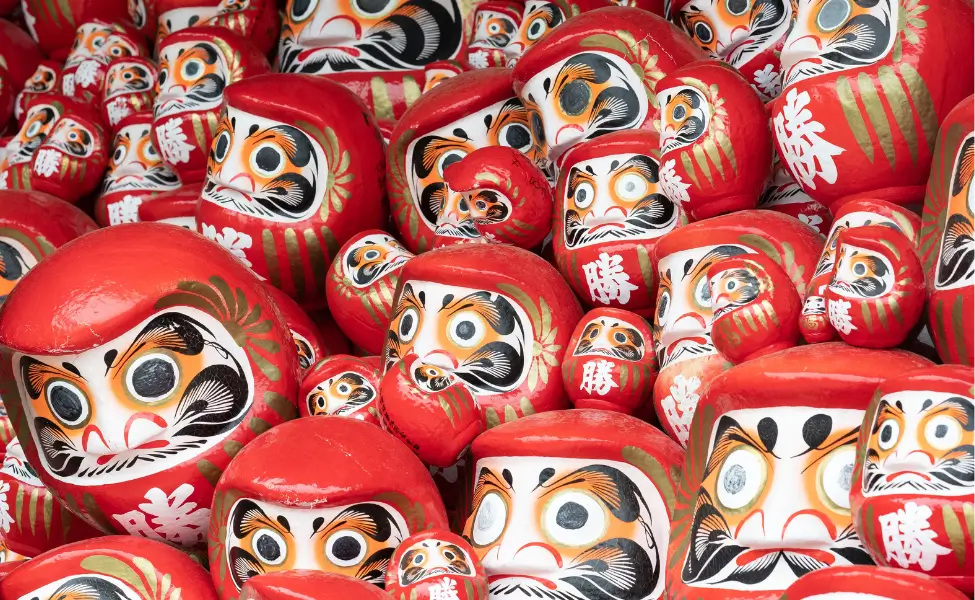
Shorinzan Darumaji Temple in Takasaki, built in 1697, claims to be the birthplace of the Japanese Daruma doll.
Over 80 per cent of Japan’s Daruma dolls are still produced in Takasaki today, and the temple grounds are stacked with dolls of every size and colour, each representing a wish or goal in progress.
Visitors paint the right eye when making a wish, then fill in the left eye when the wish comes true.
At year’s end, people return their old Daruma for ceremonial burning.
The annual Daruma market on 6 and 7 January draws large crowds and is worth timing a visit around if your travel dates allow.
Haruna Shrine presses directly into the cliff face at the end of a forested approach path on Mount Haruna.
The architecture sits close to the rock rather than in front of it, and the effect is different from most shrines built in the open. Allowing an hour is enough for most visitors.
The Usui Pass Railway Heritage Park in Annaka preserves the history of Japan’s steepest former railway line, with steam locomotives and interactive exhibits.
Adult admission is 700 yen.
The park closes on Tuesdays and from 29 December to 4 January, with opening hours from 9:00 to 17:00 between March and October and shorter hours in winter.
Honest assessment: this is a specialist attraction.
If trains are a genuine interest, it is excellent.
If they are not, put the time toward Tomioka or the onsen.
Who Gunma Is For (and Who Should Skip It)
Gunma is not for everyone, and being clear about that is more useful than overselling.
Skip Gunma if you are on your first Japan trip, your itinerary runs under eight days, and you have not yet been to Hakone or Nikko.
Those places have a stronger claim on limited time and are easier to fit logistically into a first visit.
Gunma suits travellers who already know what a standard Japan trip looks like and are ready for something that does not resemble it.
Gunma is for the traveller who has done Kyoto twice and wants something with fewer people and more texture.

It suits couples who want two nights somewhere genuinely quiet, anyone for whom onsen is an actual priority rather than a nice addition, and visitors who are happy to plan their schedule around a bus timetable in exchange for arriving somewhere that does not feel processed for tourism.
The two-day sequence that works best
- Take a morning train from Tokyo to Takasaki, then continue to Kusatsu Onsen by train and bus. Check into your ryokan early, walk to Yubatake before the light goes, and spend the evening at Sainokawara’s outdoor bath.
- Bathe again in the morning before checkout, then travel to Minakami in the afternoon. Use the remaining light for the Tanigawadake Ropeway or a walk along the Tone River. If staying overnight, book Takaragawa Onsen for the following morning before the day visitors arrive.
- Return to Tokyo from Jomo-Kogen Station, or continue to Nikko or Niigata if your route allows.
Autumn from mid-October to early November is the strongest season for the combination of foliage, mountain scenery, and cooler bathing weather.
Late May to early June is the window for Oze National Park and the flowering mizubasho.

Winter concentrates the experience around onsen and skiing, and summer opens the white-water sports from April through to October.
The travellers who get the most from Gunma are usually the ones who nearly went somewhere more obvious instead.
They arrived not quite sure what to expect, somewhere on the wrong side of a tricky bus connection.
They came back with wet hair, a Daruma doll with one eye painted, and a clear answer to the question they came here to settle.
