
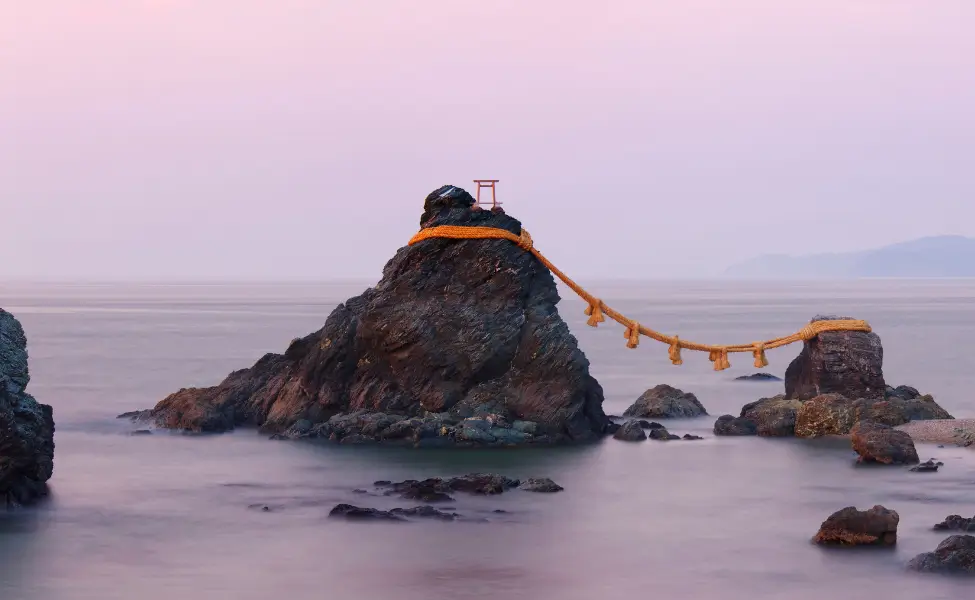
You have almost certainly seen the photo. A massive straw rope draped across a shrine entrance, or coiled around an ancient tree, or binding two sea-washed rocks together.
These ropes are called shimenawa, and once you understand what they are doing, every shrine, sacred tree, and holy rock you encounter will read differently. Not in a vague, spiritual way. In a practical, specific way that changes how you move through those spaces.
The logic behind the rope
What the word actually means
The word breaks down simply: shime means to close off or claim a space, nawa means rope.
A shimenawa is a rope that marks territory.
Not for people, but for kami, the spirits at the heart of Shinto.

The rope draws a visible line and says: what this encircles or frames belongs to a different order of things.
In Shinto, the distinction between the pure and the impure runs through almost everything.
A shimenawa makes that distinction visible.
When a shimenawa encircles something or hangs above it, it marks either a place where kami reside, a boundary at the entrance to such a place, or a space that ritual has set apart from ordinary life.
You are not necessarily being told to stay out.
You are being asked to notice the threshold.
What the shide streamers and other attachments mean
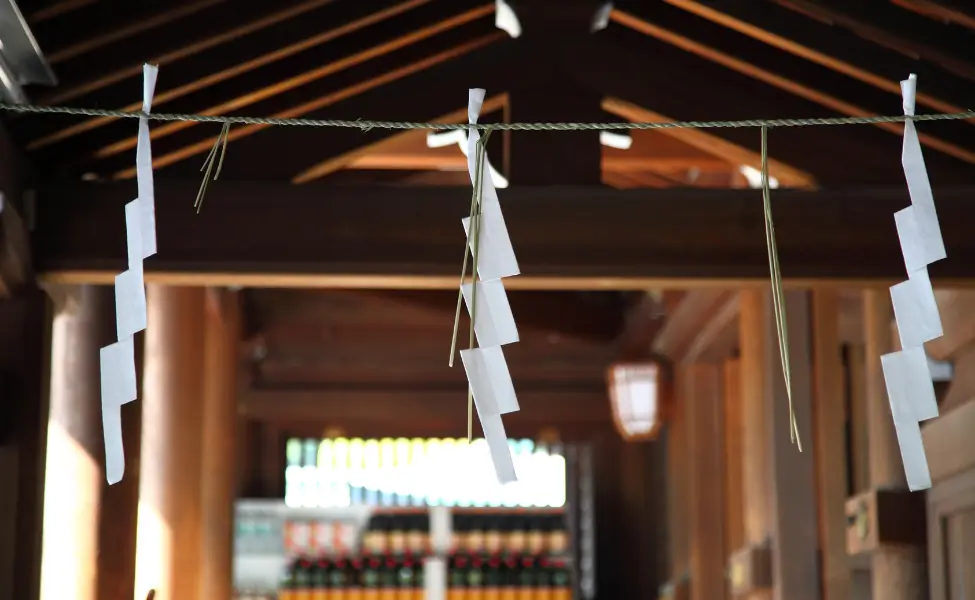
The zigzag paper streamers hanging from the rope are called shide, and they carry their own meaning.
Their folded, lightning-bolt shape signals divine presence and ritual cleanliness.
A space marked with shide has been formally purified, and the more shide you see, the more carefully the space has been prepared.
Other attachments vary by region and tradition.
Bitter oranges signal generational continuity and prosperity.
Pine twigs indicate longevity and the ongoing presence of kami.
A large bell hung at the centre, as you find at Izumo Taisha, serves purification through sound.
These combinations are not interchangeable, and the specific mix tells you something about the shrine’s tradition and the kami being honoured.
Why most shimenawa are no longer made from hemp
Most shimenawa today are made from rice straw or wheat straw rather than hemp, because the Cannabis Control Act of 1948 made hemp cultivation strictly licensed and rare.
Before that change, hemp was the traditional material, carrying its own ritual associations with purity.
At some major shrines, hemp is still sourced specifically for important ceremonial ropes.
Visitors would never know the difference from looking, but it matters if you are asking shrine staff about production or writing about traditional craft.
Where you will find them in Japan
At shrine buildings and torii gates
The most common placement is stretched beneath the eaves of the main hall (haiden), the building where worshippers approach to pray.

This rope formally separates the human side of the encounter from the kami’s side.
A shimenawa at the torii gate performs the same function at the outer boundary of the complex, marking the transition from ordinary street to sacred ground the moment you pass through.
At large shrines you will often find shimenawa in several locations at once, each marking a specific boundary within the layered structure of the space.
They are not redundant.
Reading the placement helps you understand how the shrine organises its sacred geography.
Around sacred trees and rocks
When you see a shimenawa around a tree or rock, you are looking at what Shinto calls a yorishiro, an object understood as a dwelling place for kami.
The rope does not make the tree sacred.
It acknowledges and marks a quality the tree already has in the eyes of the shrine community.
Trees given this designation are called shinboku.
A shinboku is never felled.
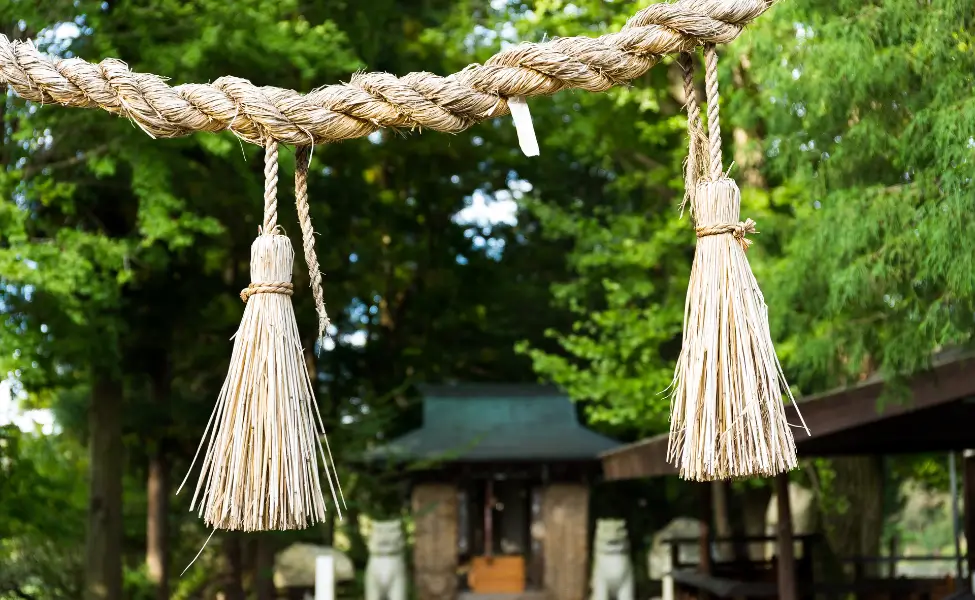
Communities have refused development projects and road construction specifically to preserve trees marked this way.
The commitment is real, not symbolic.
Rocks receive exactly the same treatment, and the most famous example, the Meoto Iwa wedded rocks at Futami, is covered in detail further below.
At ceremonies, festivals, and sumo
Shimenawa also appear well outside permanent shrine settings.
A jichinsai ground-breaking ceremony before construction begins uses a simple rope to mark the site as ritually purified.
Portable shrines during festivals are bounded by them while processions are being prepared.
Sumo carries the same sacred boundary logic.
Before tournaments, sumo officials ritually purify the dohyo.
A newly promoted yokozuna also wears a ceremonial rope around his waist, which links him visually and symbolically to shimenawa tradition.
Across all these uses, the same logic applies: the rope creates a boundary, whether in space or in time.
The rules visitors get wrong
A shimenawa does not always mean do not enter
The most common misunderstanding is that a shimenawa always means do not enter. It does not.
Passing under a shimenawa at a shrine entrance is completely normal, because that is often the path through. The rope marks a threshold you are expected to cross.
What matters is how you cross it.
What you should not do is touch the rope itself unnecessarily, pull the shide streamers, or grab the rope for a photograph.
The advice across shrine sources is consistent on this point.
Avoid direct contact unless there is a specific ritual reason to do so.
The same applies to shimenawa on trees and rocks.
Photography at shrine ropes and sacred trees
Photography is generally permitted at most shrines and is not specifically prohibited around shimenawa.
Point your camera at the rope because you want to understand it, not because you want a dramatic backdrop.
At sites explicitly marked as photography-restricted, respect the restriction without question.
The Ise Jingu exception worth knowing
An unmarked tree within a shrine compound is not necessarily an ordinary tree.
At Ise Jingu, Japan’s most important Shinto complex, every tree within the grounds carries the designation goshinboku, meaning sacred tree, so none are individually marked with shimenawa.
The entire grove holds that status, and the boundary of the complex is the boundary of the sacred space.

At other major shrine complexes, similar logic may apply to specific areas.
When you are uncertain, treat the whole precinct with the same respect the shimenawa is asking of you around the most visible objects within it.
Shimenawa at home and at New Year
What shimekazari are and why they appear everywhere in December
The household version of the shimenawa is called shimekazari, a smaller decorated rope with fern fronds, pine, bitter orange, and shide, hung above the front door.
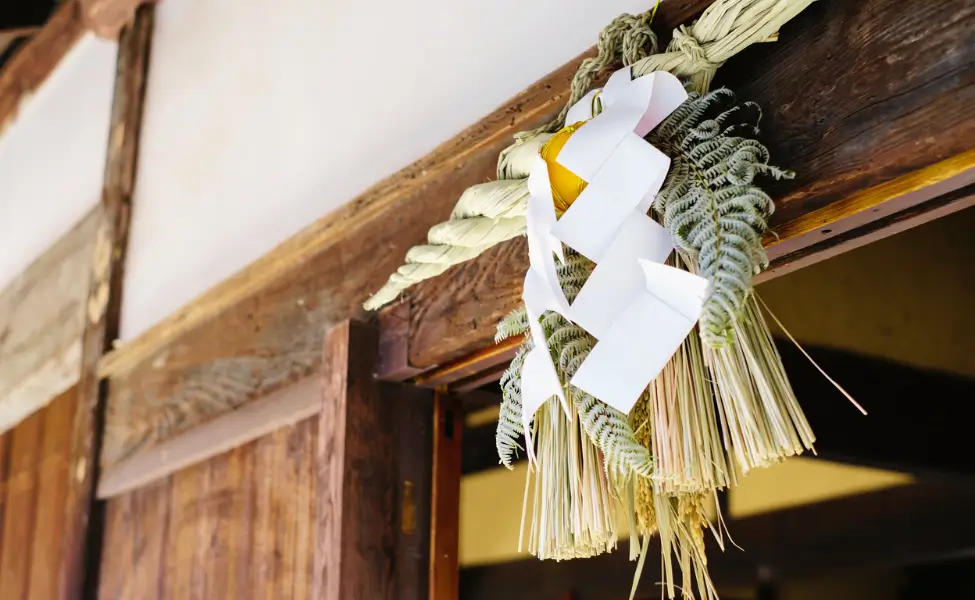
Its purpose is to prepare the home to receive the Toshigami, the New Year deity, and to keep the fresh purity of the new year intact before it has had a chance to take hold.
In the weeks before New Year, shimekazari become visible far beyond shrine grounds.
Businesses hang them above their entrances.
Apartment buildings put them over lobby doors. For a few weeks in late December and early January, the visual language of the rope saturates the urban environment in a way that does not happen at any other point in the year.
When to hang one and which dates to avoid
The timing follows specific rules worth knowing before you buy one to hang yourself or gift to someone:
- Hang it any time between 26 and 28 December, or on 30 December
- Avoid 29 December, because 29 can be read as nijuku, meaning double suffering
- Avoid 31 December, because a decoration hung the night before New Year is called ichiyakazari, which is considered insufficiently prepared
Modern Japan adapts these customs freely, and you will see shimekazari appear at various points throughout December.
But if you want to follow the tradition properly, those are the dates.
When to take it down and where it goes
When the New Year period ends, shimekazari should not go into regular household waste.
In the Kanto region, that end point is 7 January, the close of Matsu-no-uchi.
In Kansai, the tradition runs until 15 January, coinciding with Koshogatsu and the Dondoyaki fire festivals at local shrines, where consecrated New Year items are ritually burned.
Bringing your shimekazari to the local shrine for Dondoyaki is the standard practice.
Some shrines no longer accept them, so it is worth checking in advance rather than assuming.
Where to see notable shimenawa in Japan
Izumo Taisha, Shimane
The shimenawa at the Kagura-den hall changes most people’s understanding of how large a rope can become.
It measures approximately 13.5 metres long and weighs around five tons.
Residents of Iinan Town in Shimane Prefecture handcraft it through a process that takes well over a year, from rice cultivation to installation.
The shrine replaces it approximately every six years, and a ceremony will mark the next replacement in July 2026. That gives you a genuine reason to plan your timing carefully if the dates align.

Izumo Taisha draws very large crowds during October.
People elsewhere in Japan call this month Kannazuki, while Izumo locals call it Kamiarizuki, because tradition says shrines across the country send their kami to Izumo for an annual gathering.
That surge of visitors affects accommodation across the Shimane region, so book well ahead if you plan to travel in October.
Meoto Iwa, Futami, Mie
Five shimenawa ropes bind the wedded rocks at Futami together.
The site holds public replacement ceremonies three times a year, in May, September, and December.
The rocks represent the Shinto deities Izanagi and Izanami, and they serve as a torii gate to a sacred stone in the sea beyond them.

The site carries particular significance around the winter solstice, when the moon rises between the two rocks on clear evenings.
The December ceremony draws concentrated crowds to a site that is not large, and accommodation around Futami and Ise fills well in advance.
The rocks are a short walk from Futaminoura Station on the JR Sangu Line.
Nachi Falls, Wakayama
Nachi Falls drops 133 metres in a single uninterrupted cascade and carries a shimenawa marking it as a kami site.
The falls have been venerated for centuries as the original religious site in the Kumano area, and Kumano Nachi Taisha sits on the hillside above.
Hiryu Shrine stands directly adjacent to the falls and enshrines them as a sacred site in their own right.

You see one of Japan’s most compositionally striking encounters with shimenawa where the falls line up with the red pagoda of Seiganto-ji temple.
Give yourself most of the day to reach it from the nearest city, and walk the cobblestone Daimon-zaka approach from the valley if your legs allow it.
Your local neighbourhood shrine
The famous examples exist on a scale that can make shimenawa feel monumental.
At the small shrine around the corner from wherever you are staying in Japan, people keep the practice alive in ordinary time.

Parishioners probably made the shimenawa above the haiden there in late autumn, and they will replace it when the shrine’s own ritual calendar calls for it, with nobody there to watch.
Standing in front of it and understanding what it is doing is a different experience from photographing the Izumo rope.
Practical answers to the questions visitors actually ask
Yes, when the rope frames an entrance or gate. That is its intended function at those locations. Walking through a torii with a shimenawa above it, or entering the haiden under the rope, is entirely normal. Touching the rope itself is a different matter, so keep your hands clear.
Photography is generally permitted. Focus on intent and conduct. Photograph the sacred object to understand the place, not to use it as a backdrop or prop. At a small shrine with no other visitors, move more quietly and act with more care than you might at a famous tourist site.
Read the placement. A rope stretched across a path, around a rock, or encircling a section of ground that is not part of the normal visitor route is a clear signal to stay outside that boundary. A rope above an entrance is an invitation to pass through. If you are genuinely unsure, watch how local visitors behave before you move.
Because the tree has been identified as a yorishiro, a dwelling place for kami. The rope does not create that status. It makes it visible. Treat the tree as you would any other object inside a rope boundary: do not touch it unnecessarily, do not climb it, and do not break branches.
Both, depending on context. At a shrine or around a shinboku tree, it is entirely religious, functioning as a ritual boundary with real behavioural implications. As a shimekazari above a supermarket door in December, it is seasonal and cultural, drawing on the same tradition in a lighter register. Holding that distinction helps you read the context correctly when you are standing in front of one.
