
You’ve probably spent longer than you’d like trying to decide whether Kagawa deserves a spot in your Japan itinerary.
Limited days make every destination feel like a trade-off, and the fear of spending two precious days somewhere that turns out to be just okay is real.
Japan’s smallest prefecture doesn’t carry the name recognition of Kyoto, Hiroshima, or Osaka, and the scattered information online tends to either oversell it or leave out the practical details you actually need.
So here is the honest version.
Kagawa is worth visiting, and it suits a specific kind of traveller well.
It has enough variety to fill two or three days without repetition.
Takamatsu works as a practical compact base, and the Seto Inland Sea islands offer something genuinely unlike the standard Japan route.
If you’ve already seen the major first-timer cities and want somewhere with more texture and fewer crowds, Kagawa holds up.
Is Kagawa Right for You?
Kagawa earns its place in an itinerary when the traveller wants more than cities and temples.
It is great for people who appreciate Japanese gardens without fighting through a crowd.
It is not the right choice if this is your first Japan trip and you have under ten days.
The classic route, Tokyo, Kyoto, Osaka, and Hiroshima, gives a fuller introduction to the country.
Kagawa is for travellers who already have a feel for Japan or who are deliberately building an itinerary around its quieter, less photographed regions.
It works well for you if any of these apply.
- You’ve already visited or are intentionally skipping the most crowded first-timer destinations
- You want a world-class garden, contemporary art, and island scenery on the same short trip
- You’re comfortable combining trains and ferries without a car
- You want a Shikoku base that connects to the Seto Inland Sea islands
It is probably not the right choice if any of these apply.
- This is your only Japan trip and you have under ten days
- You have no interest in gardens, islands, or coastal scenery
- You want the energy and density of a major city
Getting to Kagawa
Takamatsu, the prefectural capital, connects well to the major cities of Honshu via the Seto Ohashi Bridge rail link.
Most travellers arrive by shinkansen to Okayama and transfer there to the Marine Liner rapid train for the final stretch across the bridge.
| From | Method | Approximate time | Notes |
|---|---|---|---|
| Tokyo | Fly Haneda to Takamatsu Airport | About 1 hour 20 minutes | Airport bus to central Takamatsu adds 45 minutes |
| Tokyo | Shinkansen to Okayama, then Marine Liner | About 4.5 hours | Use the Nozomi for the fastest connection |
| Osaka / Kyoto | Shinkansen to Okayama, then Marine Liner | About 2 hours | Depart from Shin-Osaka Station |
| Hiroshima | Shinkansen to Okayama, then Marine Liner | About 1.5 to 2 hours | The Okayama transfer is straightforward |
| Kobe | Jumbo Ferry | About 4 hours 45 minutes | A practical option for budget travellers from the Kansai region |
| Tokyo (budget) | Highway bus | About 10 to 12 hours | Overnight buses offset the accommodation cost |
The Okayama transfer is simple and reliable.
Once you board the Marine Liner, the train crosses the Seto Inland Sea on the Great Seto Bridge, and on a clear day the crossing itself offers a view worth staying awake for.

Takamatsu, the City That Holds It All Together
Takamatsu works well as a base because it places most of Kagawa’s main attractions within easy reach. Ferries to Naoshima and Teshima leave from the port.
Kotohira sits under an hour south by train, and Marugame is roughly 30 minutes west along the coast.
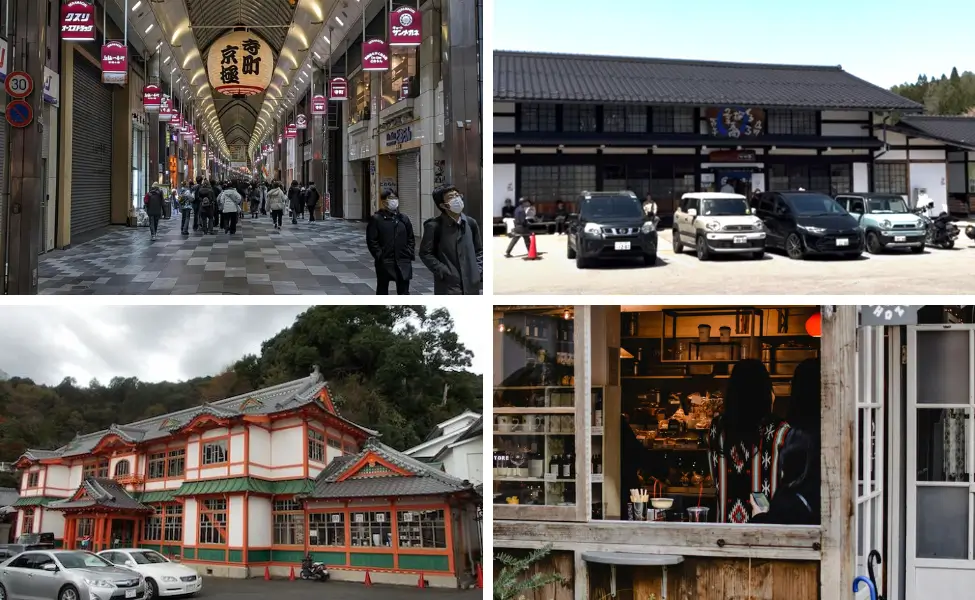
Covered shopping arcades run south from the station toward Ritsurin Garden and give the city a relaxed, lived-in feel.
The concentration of good udon restaurants here is higher than anywhere else in the country.
Ritsurin Garden
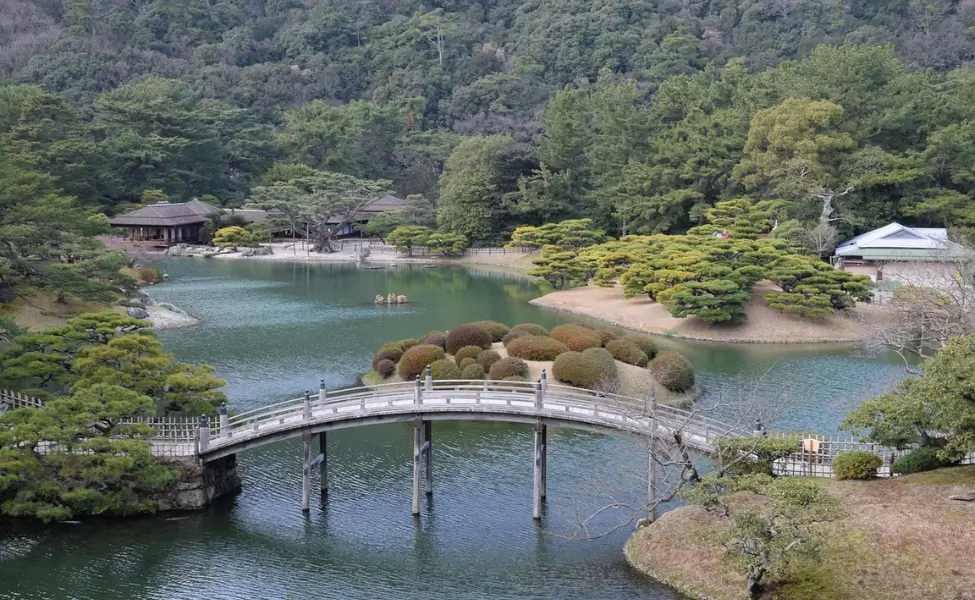
Ritsurin Garden is the centrepiece of Takamatsu and deserves most of a morning.
We drove down from Nagoya and loved walking around.
Construction began in 1625, and successive feudal lords shaped the garden over more than a century before its completion in 1745.
It covers 75 hectares, with six ponds and 13 landscaped hills arranged so that the scenery changes with each step.
Around 1,000 pruned pine trees anchor the southern section.
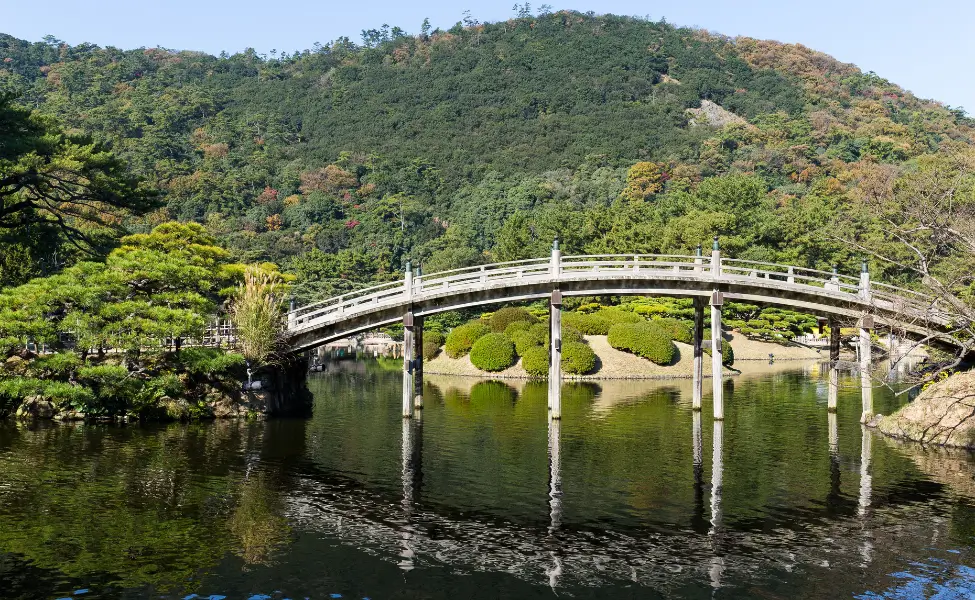
The Kikugetsutei teahouse on the south pond offers matcha with a view across the water that has changed little since the Edo period.
Michelin gives it three stars in its Japan publication, placing it alongside Kenroku-en and Korakuen as one of Japan’s finest gardens.
Takamatsu Castle
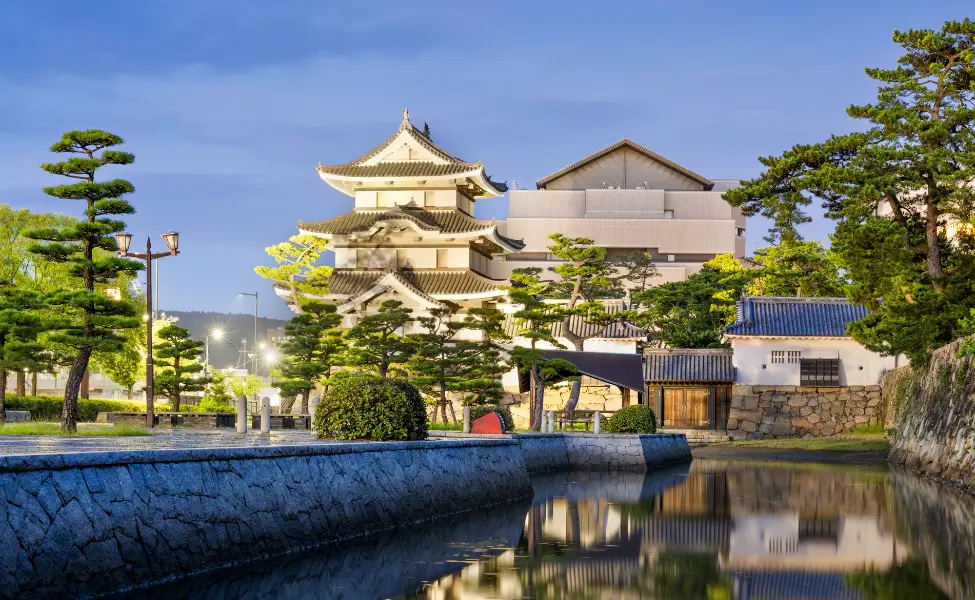
Takamatsu Castle, known locally as Tamamo Castle, dates from 1588 and sits directly on the coast.
Unlike most Japanese castles, its moats draw water from the Seto Inland Sea, and sea bream inhabit them rather than carp.
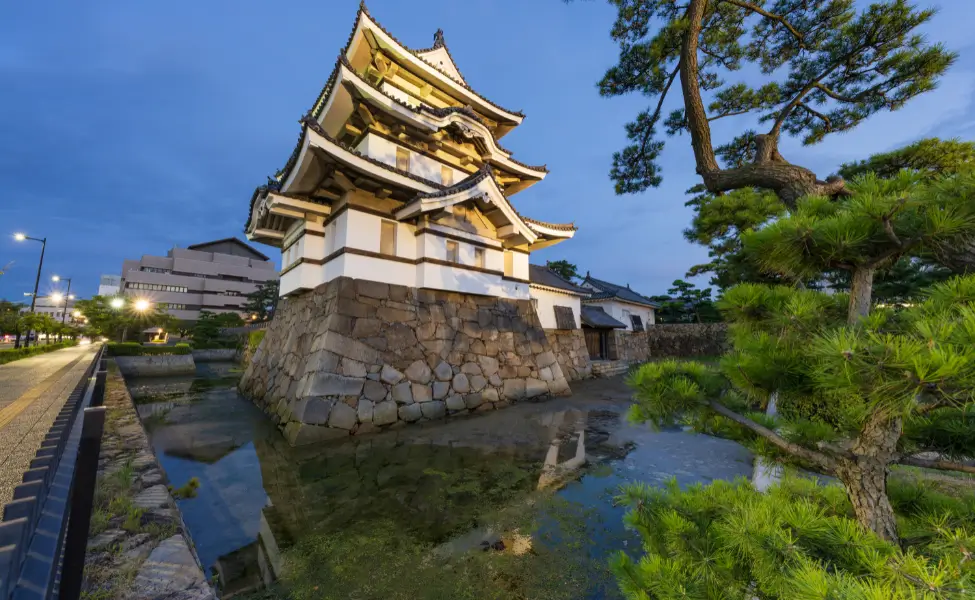
The original keep no longer stands, but the remaining stone walls, gates, and turrets are well preserved, and the grounds look out across the sea toward Shikoku’s offshore islands.
A short walk connects the castle to the waterfront district of Sunport Takamatsu and the main ferry terminal.
Yashima
Yashima is a flat-topped lava plateau rising above the eastern edge of the city, about 20 minutes from central Takamatsu by Kotoden railway or JR.
The old ropeway that once served the summit closed in the early 2000s, but a shuttle bus now runs once per hour from both Kotoden Yashima Station (10 minutes) and JR Yashima Station (about 18 minutes).
At the summit, Yashima-ji temple stands at the edge of the plateau looking out over the Seto Inland Sea.
One of the 88 temples of the Shikoku pilgrimage, the temple grounds contain a museum of artefacts from the site’s history.
Yashima also carries historical weight as the site of the 1185 Battle of Yashima, where the Taira and Minamoto clans fought a pivotal engagement in the Genpei War.
The Seto Inland Sea Islands
The islands around Takamatsu form the most distinctive part of a Kagawa visit.
Naoshima, Teshima, and Shodoshima each require a separate ferry journey and a full day.
Trying to combine all three in one trip is not realistic for most people.
Choose based on what appeals most, and treat the others as reasons to return.
Naoshima
Naoshima’s reputation as an art island is earned, but it is not a place that requires deep knowledge of contemporary art to enjoy.
Yayoi Kusama’s Red Pumpkin greets visitors as they step off the ferry at Miyanoura Port, while the Yellow Pumpkin sits at the end of a small pier near Benesse House, looking out over the sea.

It can get incredibly busy though with annoying infleuncers looking for photos.
Architect Tadao Ando designed the Chichu Art Museum and built it largely underground to preserve the island’s landscape.
Its permanent collection includes Claude Monet’s Water Lilies alongside works by James Turrell and Walter De Maria.
Benesse House combines a contemporary art museum with hotel accommodation, its galleries opening onto the hillside above the coast.
The Art House Project transforms traditional houses in the old village of Honmura into individual art installations, with a different artist shaping each one.
Walking between them takes an hour or two and feels more like exploring a living village than visiting an institution.
Ferries from Takamatsu Port reach Miyanoura in about 50 minutes.
Most venues close on Mondays, so plan accordingly.
Teshima
Teshima sits between Naoshima and Shodoshima and draws visitors primarily for its art museum.
Architect Ryue Nishizawa designed it with artist Rei Naito, shaping the structure as a low concrete shell resembling a water droplet.
Two oval openings in the roof allow wind, light, and rain to enter.

The interior holds a single artwork in which water springs from pinholes in the floor and moves across the surface in slow, shifting patterns.
Spending time inside feels less like viewing art and more like sitting inside a living landscape.
Beyond the museum, Teshima has restored rice terraces and art installations across its three fishing villages.
Shodoshima
Shodoshima is larger and more varied than the art islands, and suits travellers who want scenery and food rather than contemporary art.
Japan introduced olive cultivation to the island in 1908, and today Shodoshima produces more olives than anywhere else in the country.
Olive groves line the hillsides and the island’s food, oils, and cosmetics carry the olive theme throughout.

Kankakei Gorge, accessible by ropeway on the island’s eastern side, offers dramatic rock formations shaped by volcanic activity and views across the Seto Inland Sea.
Autumn is the best season for the gorge, when the foliage turns across the canyon walls.
At lower tide, Angel Road emerges as a narrow sandbar connecting Shodoshima to two smaller adjacent islands.
Its appearance varies with the tides and the time of year, and local couples treat the walk as a tradition in its own right.
Between Naoshima’s art, Teshima’s contemplative museum, and Shodoshima’s scenery and food, the islands are the main reason Kagawa feels different from a standard Honshu itinerary.
Nothing else on the usual tourist route offers quite the same combination.
Kotohira and Marugame
Both towns are easily reached from Takamatsu by train, each taking under an hour, and neither requires a full day on its own.
Combining them makes for a well-rounded second day that adds history and a genuine sense of regional Japan without the need for a car.
Kotohira and Kompira-san
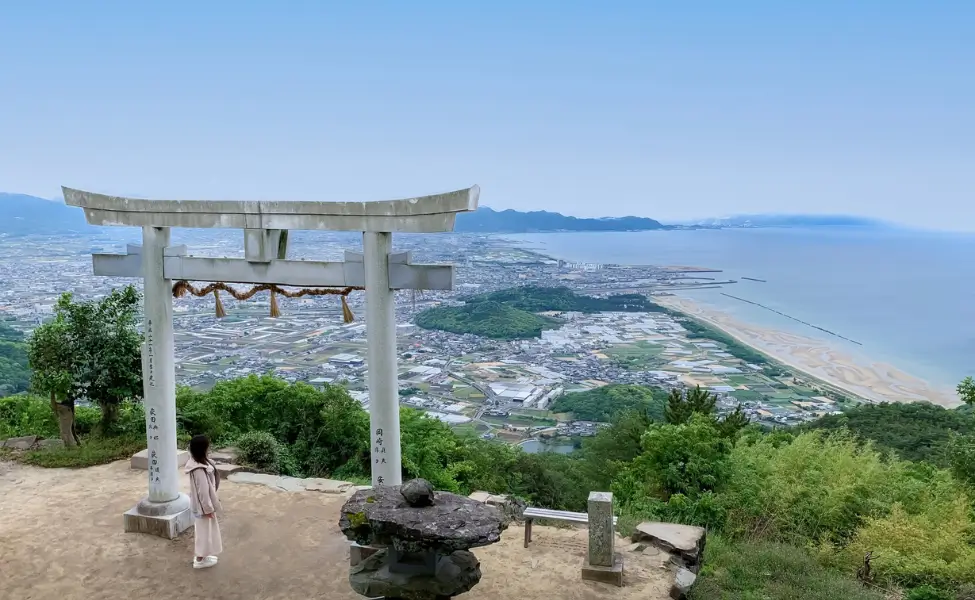
Kotohira’s main draw is Kotohira-gu, known throughout Japan as Kompira-san.
The shrine sits on the wooded slopes of Mount Zozu and has served as a place of pilgrimage for sailors and maritime workers for centuries.
Its principal kami is Omononushi, the deity associated with safe voyages.
The shrine leads a network of around 600 Kotohira shrines spread across Japan.
Reaching the main shrine means climbing 785 stone steps from the town below.
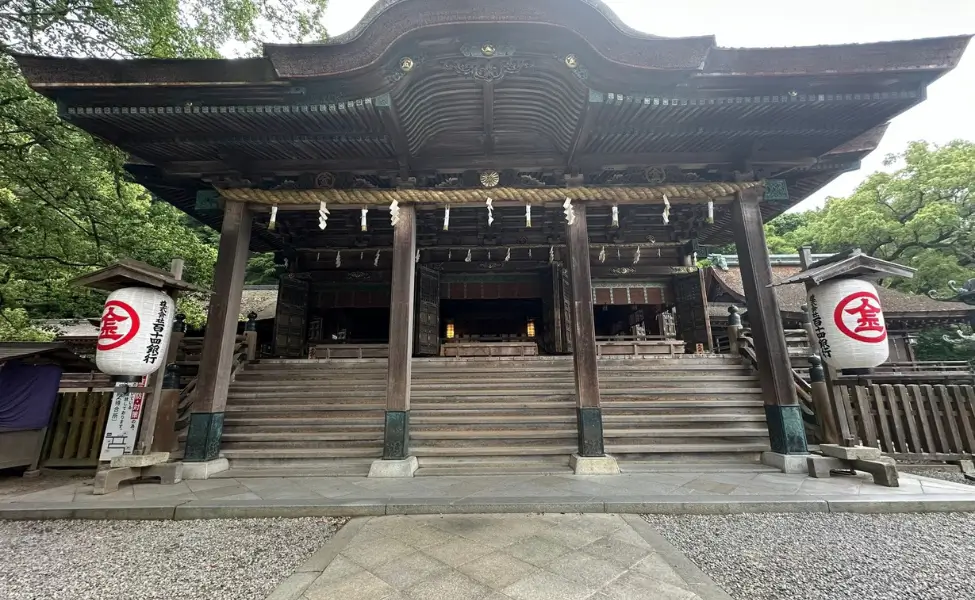
The climb takes roughly 45 minutes at a comfortable pace.
Along the way you pass secondary shrines, a sake museum, and views of the Sanuki Plain that open up through the trees.
Here is what you encounter as you ascend:
- The lower arcade section, lined with souvenir shops and udon restaurants
- The Ōmon Gate and Asahi-sha shrine building, with its intricately carved gables
- The Treasure Hall and the Shoin drawing room, which displays Edo-period painted screens
- The main shrine hall (Gohon-gu) at step 785, with views over the Sanuki Plain and the Seto Inland Sea on clear days
From the main shrine, determined walkers can continue a further 583 steps to the inner shrine at step 1,368.
The extra effort brings a wide view across the surrounding landscape in every direction.
Marugame Castle
Marugame Castle is one of only twelve Japanese castle keeps that survive in their original wooden form.
It sits on a small hill at the centre of the city, and tiered stone walls curve upward in a distinctive fan shape.
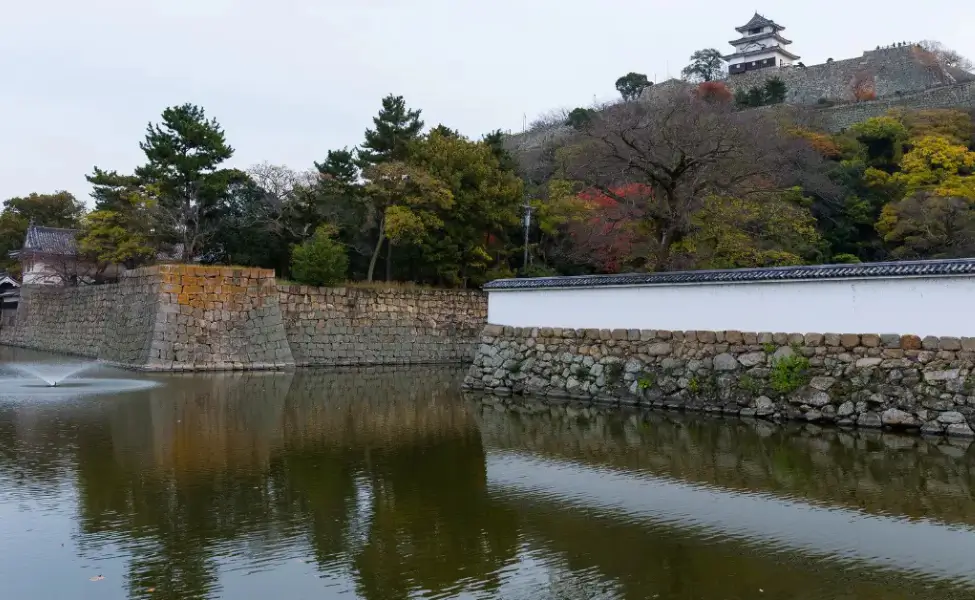
The keep stands three storeys tall and is sometimes called the smallest castle keep in Japan.
Despite its modest size, the contrast between the compact white tower and the sweeping stonework below makes the structure a striking sight.
A 15-minute walk south from Marugame Station brings you to the entrance.
The keep is open for visitors, and the view from the top floor takes in the Seto Inland Sea.
On clear days, the Great Seto Bridge connecting Shikoku to Honshu comes into view.
Nearly 1,000 cherry trees line the grounds, and the castle holds National Historic Site status.
Planning Your Time in Kagawa
How many days
One day is possible but requires selective planning.
A realistic single day covers Ritsurin Garden in the morning and a ferry to Naoshima in the early afternoon.
Check ferry schedules before you go, and plan to visit one or two venues on the island rather than trying to cover everything.
Bear in mind that Naoshima venues close on Mondays.
If that day falls in your window, skip the island and spend the day in Takamatsu and Kotohira instead.
Two days is the sensible minimum.
Spend the first in Takamatsu and on Naoshima, and the second on Kotohira and Marugame.
This covers the most essential stops without rushing any of them.
Three days is the comfortable version.
The extra time lets you add a second island, stay overnight on Naoshima or Shodoshima, or simply slow down.
Adding a third day also works well if you want to combine Kagawa with Matsuyama or Tokushima on a broader Shikoku loop.
Best seasons
- Spring (late March to early April). Cherry blossoms at Marugame Castle and Ritsurin Garden draw visitors, and this is the busiest time of year.
- Autumn (October to November). Clear skies, the best conditions for Kankakei Gorge, and evening illuminations at Ritsurin Garden. Kagawa’s low annual rainfall suits this season particularly well.
- Summer (July to August). Beaches and the Seto Inland Sea at their warmest. The Setouchi Triennale, a contemporary art festival held across the islands every three years, adds a significant number of visitors in festival years.
- Winter (December to February). Quiet, mild by Japanese standards, and largely uncrowded. A good season for gardens, temples, and working through Kagawa’s udon shops without a queue.
What to eat
Sanuki udon is the obvious starting point.
The noodles are thick and chewy, served in a dashi broth with toppings ranging from tempura to raw egg.

Nakano Udon School in Takamatsu runs udon-making classes if you want to go further than eating them.
Beyond udon, these are the local foods worth tracking down.
- Olive beef. Raised on Shodoshima on a diet that includes residue from olive pressing, the meat carries an unusually clean flavour
- Olive yellowtail. Farmed in the Seto Inland Sea using the same olive feed system, and available fresh across the prefecture
- Shodoshima soy sauce. Over 20 traditional breweries still ferment in wooden barrels on the island, and the quality differs markedly from mass-produced alternatives
- Wasanbon sugar sweets. A refined Japanese confectionery with a long Kagawa tradition, sold in elegant boxes and worth picking up before you leave
Should You Visit Kagawa?
With two or three spare days on a trip covering Osaka, Hiroshima, or Kyoto, Kagawa gives you something the standard route doesn’t.
Takamatsu works as a compact base, Ritsurin Garden is worth a morning, and one island gives you an experience the standard Honshu route doesn’t replicate.
The travellers who leave most satisfied are those who chose it deliberately.
If the islands interest you, or if you’d rather walk a quiet fishing village than queue for another temple, this prefecture justifies the detour.
A garden that took a century to complete is not a minor attraction.