

The best Japanese gardens look completely different depending on when you visit.
Cherry blooms in spring or fiery maples in autumn transform the same space entirely.
While Kyoto’s classical Zen gardens draw massive crowds, places like Shirotori Garden offer the same beauty without the tourists.
Some gardens cost ¥900 to enter, others are free.
Knowing the differences helps you plan the perfect garden tour.
Visit the best Japanese gardens with these experineces.
Understanding Japanese Garden Types
Before you explore, it helps to know what you’re seeing.
Japanese gardens fall into four main styles:
Karesansui (Zen rock gardens) use gravel and stones to represent water and mountains.
No actual water flows here.
The famous rock garden at Ryoan-ji in Kyoto is the best example.

Tsukiyama (hill gardens) recreate natural views in miniature.
Hills, ponds, and paths invite you to walk and discover new views at every turn.
Chaniwa (tea gardens) lead to tea houses through simple, rustic paths.
Stone lanterns called torō light the way.
Kaiyū-shiki (strolling gardens) wind around a central pond.
You follow the path to see the garden from many angles.
Most of the gardens in this guide use this style.
Garden Terms to Know
Torō – Stone lanterns that line garden paths
Shakkei – “Borrowed scenery” where distant mountains or forests become part of the garden view
Chaniwa – Tea garden designed for the tea ceremony approach
Seasonal Beauty in Japanese Gardens
Timing matters.
Each season paints Japanese gardens in different colors and moods.
Spring brings the famous cherry blooms from late March through April.
Crowds come to see the soft pink flowers that last only two weeks.
Summer offers deep greens and lotus flowers on pond surfaces.
Early mornings are best to avoid the heat.
Autumn (mid-November to early December) sets the maple trees ablaze in red and orange.
This is many visitors’ favorite season.
Winter reveals the garden’s bones. Snow-covered pines and quiet paths create a meditative atmosphere.
Cherry Blooms of Spring
Come spring, the cherry bloom steals the show.
These delicate flowers create a pink canopy that shows the brief beauty of life.
This idea, called mono no aware, sits at the heart of Japanese culture.
Visit Hirosaki Castle Botanical Garden in Aomori to see hundreds of cherry trees surrounding serene ponds and landscaped paths.

The view of blossoms mirrored in the water with the castle in the background feels almost surreal.
Best time: Late April to early May
Entry: ¥320
Hours:9:00–17:00 (varies during festival period)
Nearest station: Hirosaki
Autumn’s Maple Trees
As autumn arrives, maple trees turn bright red and orange against evergreen pines and late-blooming flowers.
The contrast stops you in your tracks.
Gardens like Koraku-en and Kenroku-en become living art galleries during this season.
Tip: Visit on weekday mornings to avoid crowds, especially mid to late November.
Famous Japanese Gardens to Explore
These gardens earned their fame through centuries of careful design and maintenance.
Each offers a different window into Japanese garden art.
The Three Great Gardens Explained
Japan’s “Three Great Gardens” (Nihon Sanmeien) earned this title in the Edo period.
Each shows different aspects of perfect garden design.
Together, they demonstrate six key elements: spaciousness and seclusion, artifice and antiquity, water-courses and panoramas.
Koraku-en: Harmony and Space
In Okayama, Koraku-en spreads across 13 hectares of ponds, tea houses, and wide lawns.
Unlike many Japanese gardens, Koraku-en lets you walk on the grass.

This garden reflects the Edo period’s love for harmony between people and nature.
The Yuishinzan hill gives you views across the entire garden to Okayama Castle beyond.
This is shakkei, borrowed scenery, at its finest.
Best time: Weekday mornings
Entry: ¥500
Hours: 7:30-18:00 (seasonal)
Nearest station: Okayama (~25-minute walk or tram to Shiroshita + 10-minute walk)
Note: Views from Yuishinzan include Okayama Castle as classic shakkei.
Kenroku-en: Six Perfect Features
Kenroku-en in Kanazawa takes its name from the six features of an ideal garden.
The famous Kotoji-torō lantern, shaped like a harp bridge, stands as the garden’s symbol.
Japan’s oldest fountain still works using natural water pressure from a nearby pond.

Winter brings a unique sight: yukitsuri, ropes tied from tree centers to branches to protect them from heavy snow.
This is my personal favourite of the big three.
Best time: Early morning or late afternoon
Entry: ¥320 (free during early-admission hours)
Known for: Kotoji-torō, yukitsuri in winter, and one of Japan’s oldest gravity-fed fountains
Nearest station: Kanazawa (bus or 30-minute walk)
Kairakuen: The Plum Grove
Kairakuen in Mito stands out for its 3,000 plum trees of 100 different types.

Visit in late February through March when the Plum Festival fills the air with sweet scent.
White, pink, and red blooms create a fragrant paradise.
Best time: Late Feb-Mar (Plum Festival)
Entry: Varies, typically ¥320 during the festival.
Outside the festival the main garden may be free at certain times (e.g., before 9:00).
Nearest station: Mito (bus or 20-minute walk)
Katsura Imperial Villa: Elegant Design
Kyoto’s Katsura Imperial Villa shows the peak of Japanese garden design.
The garden centers on a pond with winding paths leading to tea houses and viewing platforms.
Each structure reveals the grace of traditional design.
Hidden Gems Worth Visiting
These gardens offer calm moments away from the usual tourist paths.
The crowds thin out, but the beauty remains.
Hori Teien (Tsuwano)
Tsuwano earns its nickname “Little Kyoto of Shimane” honestly.
Hori Teien might not ring bells like Kyoto’s famous gardens, but this hidden spot rewards those who make the trip.
The garden sits in a valley surrounded by mountains, creating natural shakkei.
Entry: ¥500
Hours: ~9:00-16:00
Closed: Mondays
Nearest station: Tsuwano (bus/taxi onward)
Shirotori Garden (Nagoya)
Step into Shirotori Garden to find Nagoya’s quieter side.
The landscape blends city and nature.

Water flows from mountain streams (recreated) to a central pond representing the sea.
This shows how Japanese gardens compress vast natural scenes into walkable spaces.
Entry: ¥300
Hours: 9:00-17:00 (closed Mondays)
Nearest station: Atsuta Jingu Nishi (Meijo Line), Exit 4, ~7-10 min walk
Mejiro Garden (Tokyo)
This small garden in Tokyo’s Toshima Ward offers an escape from the urban rush.
Though compact, it delivers a full garden experience: seasonal flowers, a calm pond, and the rustle of bamboo in the wind.
The tea house overlooks the water.
Entry: Free
Hours: 9:00-17:00 (to 19:00 in Jul-Aug)
Closed: 2nd & 4th Mondays
Sankei-en Gardens (Yokohama)
Just south of Tokyo, Yokohama offers this peaceful retreat.

Sankei-en spans 175,000 square meters and houses historic buildings moved from Kyoto and Kamakura.
Each structure tells its own story against the backdrop of seasonal changes.
The three-story pagoda from 1457 sits on a hilltop overlooking the garden.
Best time: Cherry blossom or autumn color
Entry: ¥900
Hours: 9:00-17:00 (last entry 16:30)
Note: Hilltop 1457 three-story pagoda
Island Gardens Worth the Journey
After seeing the mainland classics, Japan’s island gardens reveal how regional climates and cultures shape garden design differently.
The Natural Escapes of Kagawa Prefecture
In Kagawa Prefecture, olive trees replace traditional pines in some gardens.
Shikoku Mura, an open-air museum, shows how traditional rural life and garden design intertwine.
The museum sits among gardens that offer an escape from modern life’s noise.
Entry: ¥1,600 adults
Closed: Tuesdays
Access: Yashima area (bus)
Miyakojima Botanical Gardens (Okinawa)
Travel to Miyakojima for tropical garden design.
If that’s too far, you can enjoy my walk around it.
This botanical garden bursts with native plants you won’t see elsewhere in Japan.
Bright bougainvillea, swaying palm trees, and coral stone walls replace the usual garden elements.
Entry: Free
Best time: Year-round (avoid typhoon season Jul-Oct)
Fukushu-en Garden (Naha)
Fukushu-en Garden honors Naha’s sister city, Fuzhou, China.
Designers created this garden using feng shui rules, making it a place of balance.
Stone bridges arc over koi ponds filled with Chinese flora not found in traditional Japanese gardens.
Entry: ¥200 adults (¥100 children)
Hours: 9:00-18:00
Closed: Wednesdays
Nearest station: Prefectural Office, ~10 min walk
Shikisai no Oka (Hokkaido)
After the southern islands’ lush greenery, Japan’s northern reaches reveal a completely different face of garden art.
In Hokkaido, Shikisai no Oka spreads panoramic flower fields across rolling hills.
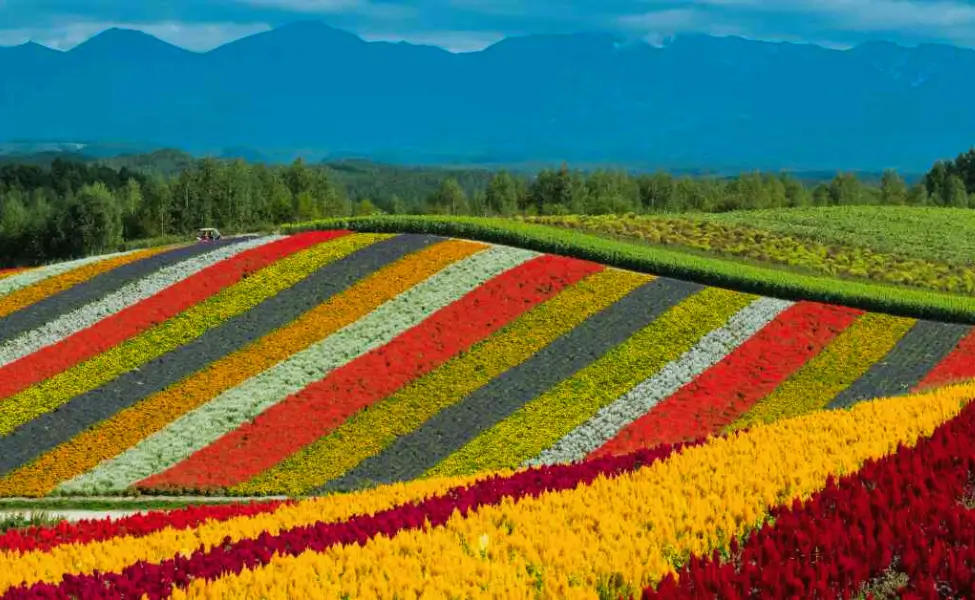
This vast carpet of vibrant blooms set against deep green hills and brown earth creates a visual feast unlike anywhere else in Japan.
Best time: Apr-Oct (peak Jul-Aug)
Entry: ¥500 (charged Jul-Sep)
Access: Car recommended.
JR Bibaushi is the nearest station
Ritsurin Koen (Takamatsu)
Ritsurin Koen in Takamatsu brings six centuries of garden design together in one space.

Traditional tea houses overlook ponds and mini-mountains that recreate natural views in miniature.
Bring your camera for this one.
We enjoyed eating Sanuki udon here.
Entry: ¥500 adults (some sources list older price ¥410)
Hours: Vary by month, roughly sunrise-sunset
Nearest station: JR Ritsurin-Koen-Kitaguchi, ~3 min walk
Regional Garden Guide
Kyoto Region: Classical elegance, Zen rock gardens, tea gardens.
Dense with famous sites.
Okayama & Kanazawa: Spacious strolling gardens with wide lawns and large ponds.
Less crowded than Kyoto.
Tokyo Area: Urban gardens offering calm in the city.
Smaller but well-maintained.
Okinawa: Tropical style with Chinese influence.
Unique plants and coral stone features.
Hokkaido: Flower fields and European-influenced designs. Best in summer.
Planning Your Garden Visits
Entry fees: Most gardens cost ¥300-900. Imperial properties require advance reservations with fees.
Best times: Weekday mornings (7:30-9:00 AM) before tour groups arrive.
Late afternoons also quiet down.
What to bring: Comfortable walking shoes, camera, small cash (many don’t take cards).
Time needed: Allow 45-90 minutes per garden for a relaxed visit.
Seasonal peaks: Cherry blossom season (late March-April) and autumn colors (November) bring the biggest crowds.
The gardens show you Japan’s soul through nature, design, and centuries of careful thought.
Take your time.
Sit on the benches
Listen to the water and let each garden reveal itself slowly.

