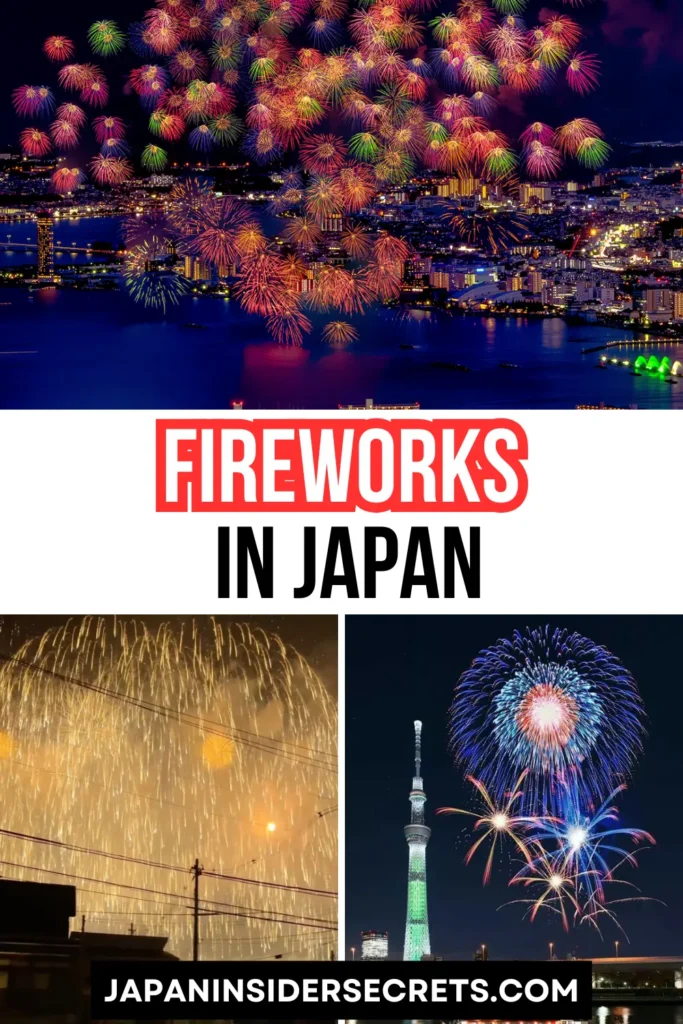

Fireworks in Japan are far more varied than the same three famous names most travellers keep seeing online.
Japan holds over 200 fireworks festivals between June and September, but Sumida River, Nagaoka, and Omagari tend to dominate the conversation.
Each one suits a different kind of visitor. Sumida gives you Tokyo scale.
Nagaoka gives you emotional depth.
Omagari gives you serious pyrotechnic skill.
Smaller local festivals can also be a better fit if you want less stress, easier movement, and more breathing room.
Why the Most Famous Night Is Not Always the Right Choice
The most famous festival is not automatically the right choice for you.
Choosing by name recognition alone is how some visitors end up frustrated.

Sumida River fireworks in Tokyo are genuinely extraordinary.
They draw close to a million people along a stretch of river where viewing areas are tightly managed and pedestrian traffic moves in one direction for hours.
For a first-time visitor who has not navigated Tokyo at rush hour, let alone at festival capacity, the experience can feel overwhelming before the first firework goes up.
This is not the kind of event where you can simply turn up and hope for the best.
That does not mean you should avoid Sumida.
Your choice should match your priorities, your crowd tolerance, and how the festival fits your itinerary.
A well-regarded festival in a medium-sized city often delivers more atmosphere, better sightlines, and less post-show transport stress than Tokyo’s flagship event.
Many visitors who have attended both Sumida and Nagaoka will tell you the night in Nagaoka left a stronger impression.
Scale matters, but it is not the only measure of a great night.
Two other misconceptions are worth clearing up before you plan.
Paid seating is not always necessary.
Free vantage points exist at most major events, and arriving several hours early is often enough to claim a good one.
Wearing a yukata as a non-Japanese visitor is also acceptable and often welcomed.
It signals participation rather than observation, and many Japanese people at the festival will respond warmly to it.
The Three Festivals Worth Planning Around
Japan holds over 200 fireworks festivals between June and September.
Most are local events that welcome visitors warmly but require no special planning.
The three festivals below represent different scales, different atmospheres, and different levels of logistical effort.
One of them is almost certainly the right fit for your trip.
| Festival | Location | Dates | Crowd Level | What Sets It Apart |
|---|---|---|---|---|
| Sumida River | Tokyo | Last Saturday of July | Very high (close to a million) | Scale, history since 1733, Tokyo Skytree backdrop |
| Nagaoka | Niigata Prefecture | August 2 and 3 | Very high (over a million across both nights) | Emotional depth, Phoenix display, strongest cultural weight |
| Omagari | Daisen, Akita Prefecture | Last Saturday of August | Very high (over 700,000) | National competition format, daytime and evening displays |
Sumida River Fireworks Festival
Tokyo’s Sumida River festival is the oldest on record in Japan. Its origins trace to 1733, when the eighth shogun Tokugawa Yoshimune ordered fireworks near Ryogoku Bridge.

The ceremony consoled the spirits of those killed by the Kyoho famine and prayed for an end to the accompanying epidemic.
What began as a ritual became a city-wide summer tradition, was interrupted during wartime, and revived under its current name in 1978.
Today it draws close to a million people every last Saturday of July.
The festival launches around 20,000 fireworks from two points along the river over approximately 90 minutes, starting at around 7:00 pm.
Safety restrictions on the launch site limit the maximum shell size.
This forces pyrotechnicians to achieve their effects through exceptional technical artistry rather than raw scale.
The riverside areas fill from around 3:30 pm, Asakusa Station operates crowd-flow restrictions on festival evenings, and leaving the area after the finale typically takes 60 to 90 minutes of slow movement.
You will be managing the crowd from the moment you arrive to the moment you get home.
The best free vantage points are Sumida Park and the roads around Shioiri Park further north, where the crowd thins slightly but the view remains strong.
For a fixed position with less crowd contact, the Tokyo Skytree observation deck is worth considering, but tickets sell out weeks in advance.
Sumida is the right choice if you are already based in Tokyo and want the full-scale urban festival experience.
For a first-time visitor concerned about managing large crowds in an unfamiliar city, it is the harder introduction to Japanese fireworks.
Nagaoka Fireworks Festival
If there is one festival in Japan that goes beyond spectacle into something that genuinely moves people, Nagaoka is it.

Nothing else on this list carries the same emotional weight, and the experience makes that clear.
If you want an honest recommendation for a first major fireworks festival in Japan, choose Nagaoka.
The festival began in 1946, one year after American air raids destroyed much of the city on August 1, 1945, killing around 1,500 people.
Every year on August 2 and 3, the city launches over 20,000 fireworks along the Shinano River as a memorial to those who died and a prayer for lasting peace.
Attendance regularly exceeds a million people across both nights.
The programme opens with three white chrysanthemum fireworks called Shiragiku, fired in complete silence as a memorial signal.
Nobody speaks while they burn.
Displays then begin in earnest, running from approximately 7:20 pm to 9:10 pm each night.
The signature piece is the Reconstruction Phoenix, a five-minute display spanning approximately 2 kilometres of the river, accompanied throughout by a full orchestral soundtrack.
Getting there by Joetsu Shinkansen from Tokyo Station takes around one hour and 40 minutes.
A clearly marked walking route from Nagaoka Station to the venue takes 20 to 30 minutes.
Post-show transport is more manageable than Sumida, provided you book your return seat before leaving Tokyo.
Festival-night trains fill completely, and there are no last-minute options.
Paid seats along the riverbank sell out months in advance through the official lottery, but free viewing areas exist further along the river.
Arriving by early afternoon gives you a realistic chance of a good free position.
Omagari National Fireworks Competition
Omagari is different from every other festival on this list because the fireworks are not the backdrop to a cultural event.
They are the entire point, and the event is structured entirely around demonstrating what Japanese pyrotechnicians can do at the highest level.

Since 1910, pyrotechnicians from across Japan have gathered in Daisen City in Akita Prefecture to compete on the banks of the Omono River.
The competition spans both daytime and evening display categories, making Omagari the only major Japanese fireworks event to feature a formal daytime competition.
Judges assess each entry on design, colour, and creative execution, which means every display pushes at the edges of what the medium can do.
The overall winner receives the Prime Minister’s Award.
Running on the last Saturday of August, the event draws over 700,000 spectators.
Getting there from Tokyo takes approximately three hours by the Akita Shinkansen Komachi service.
Most people who make the trip came specifically for the fireworks, and that tends to produce an unusually engaged atmosphere at the venue itself.
The walk from Omagari Station to the viewing area is clearly signposted and takes around 30 to 40 minutes.
Book your reserved seats and return train in both directions well in advance, as both sell out long before festival day.
Accommodation in and around Omagari fills months ahead, so securing a room early is not optional.
Why Smaller Fireworks Festivals Are Worth Considering
Japan’s major fireworks festivals get most of the attention, but smaller local hanabi events can be a better fit for many visitors.
They usually draw fewer people, the viewing areas are easier to understand, and the journey back to your hotel is less stressful.
Here is a 4K walk around Toyohama in Aichi prefecture as the fireworks festival gets ready.
You may not get the same scale as Nagaoka or Omagari, but you often get a warmer local atmosphere, better food stall access, and more space to enjoy the evening.
These smaller festivals are especially worth considering if you are already staying in a regional city, travelling with children, nervous about large crowds, or building a slower itinerary.
Across Japan, local fireworks nights are held at rivers, beaches, ports, castle towns, and summer matsuri weekends.
They may not appear on international lists, but they can still become one of the most memorable evenings of your trip.
The trade-off is that smaller events require a little more checking.
English information may be limited, dates can change, and cancellation updates are usually posted only on local city or tourism websites.
If you find a smaller festival near where you are already staying, check the official site, confirm transport options, and ask your hotel whether the event is straightforward to attend.
For a first Japan trip, choose a major festival if fireworks are one of the main reasons for your visit.
Choose a smaller local festival if you want atmosphere, easier movement, and a lower-stress evening.
Getting There Without the Stress
Transport is where plans most often go wrong at Japanese fireworks festivals.
The key principle is the same across all three events.
Arrange your onward journey before the fireworks end, not after.
Sumida River
- Take the Tokyo Metro Ginza Line or Toei Asakusa Line to Asakusa Station, arriving by 3:30 pm if you want a free riverside position.
- Kuramae Station on the Toei lines serves the second venue and is significantly less congested than Asakusa.
- After the show, wait at least 60 to 90 minutes in a nearby restaurant or bar before attempting the station. The crush immediately after the finale is severe.
- The Japan Rail Pass does not cover the Tokyo Metro lines you need for this festival. Have a Suica or IC card topped up before you arrive.
Nagaoka
- Take the Joetsu Shinkansen from Tokyo Station to Nagaoka Station, around one hour and 40 minutes. The Japan Rail Pass covers the full journey.
- Book your return Shinkansen seat before leaving Tokyo. Festival-night trains fill completely, and there are no last-minute options.
- The area around the venue is largely car-free on festival days. Walking is your primary option once you arrive in the city.
- Plan your post-show walking route to the station before the fireworks start. Some return routes run longer than visitors expect.
Omagari
- Take the Akita Shinkansen Komachi service from Tokyo Station to Omagari Station, approximately three hours. The Japan Rail Pass covers this route.
- Book reserved seats in both directions well in advance. They sell out long before festival day.
- The walk from Omagari Station to the venue takes around 30 to 40 minutes and is well signposted throughout.
- Book accommodation in the area the night before the festival. Omagari has limited options and everything nearby fills months in advance.
How to Handle the Crowds
The crowds at major Japanese fireworks festivals are real, and pretending otherwise serves nobody.
Stress on the day almost always traces back to arriving too late, standing in the wrong spot, or leaving at the worst possible moment.
Following the steps below removes most of those causes.
- Arrive at least three hours before the display starts. For Sumida, that means being at your chosen spot by 4:00 pm at the latest. For Nagaoka and Omagari, mid-afternoon arrival puts you well ahead of the main wave.
- Check the venue map before leaving your accommodation. Every major festival publishes a layout showing viewing zones, toilet locations, and entry points. Knowing your route before you arrive removes the single biggest source of festival-day anxiety.
- Choose your exit strategy while you are still calm. Identify the station you are heading for and the route to reach it. Decide in advance whether to leave a few minutes before the finale to beat the surge, or wait after the show until the crowd disperses.
- Move with the crowd, not against it. Japanese festival crowds are orderly and largely self-directing. Following the guidance of staff on the ground is reliable. Cutting across the flow is where people run into trouble.
- If you have paid seating, arrive at the gate by the time stated on your ticket. These seats guarantee your position, but gates do not hold for late arrivals.
What the Night Actually Feels Like
By late afternoon at any of these festivals, the streets around the venue have already changed completely.
This catches most first-time visitors off guard.
At the food stalls you will find the same staples across almost every summer matsuri.
Takoyaki (small batter balls with octopus inside), yakisoba (griddled noodles with vegetables and pork), yakitori (grilled chicken skewers), and kakigori (shaved ice with flavoured syrup) all appear in some combination.

You eat standing or sitting on a ground sheet, usually with a cold beer or canned drink from a nearby vending machine.
Cash is essential, as food stalls operate without card payment.
A few things are worth packing for the night:
- A lightweight ground sheet or picnic mat for open viewing areas
- Cash in small denominations for food stalls and vending machines
- A small towel and portable fan for the heat before sundown
- A light layer for after the show, when temperatures drop noticeably
- A fully charged portable battery for your phone
- Insect repellent for riverside venues
When the fireworks begin, the crowd goes quiet in a way that surprises most foreign visitors.
There is no persistent talking over the display.
People watch, and at Nagaoka in particular, the silence between bursts makes the scale of each shell more striking than any photograph conveys.
Fireworks Festivals Outside Summer
If your Japan trip falls outside July and August, the season does not end with summer.
Several events across autumn and winter are worth the journey in their own right.
The Chichibu Night Festival in Saitama Prefecture runs on December 2 and 3 each year.
A procession of six enormous ornate floats combines with a fireworks display running from 7:30 pm to 10:00 pm on the main night.
Seeing fireworks against a cold, clear December sky rather than the haze of August is a distinctly different experience.
UNESCO recognises the festival as an Intangible Cultural Heritage, and Chichibu is around 80 minutes from Ikebukuro by the Seibu Railway limited express.
Between late January and late February, the Lake Kawaguchi Winter Fireworks run on weekends at Oike Park in Yamanashi Prefecture.
Each display lasts around 20 minutes, starts at 8:00 pm, and is free to attend.
Mount Fuji serves as the backdrop from many viewing positions around the lake.
The Atami Marine Fireworks Festival runs more than ten times a year across all four seasons at Atami Bay in Shizuoka Prefecture.

Atami is about 50 minutes from Tokyo by Shinkansen.
Each display runs for around 20 minutes, and the surrounding hills amplify the sound considerably.
The bay setting produces a visual effect impossible to replicate at a river venue.
For anyone whose trip falls outside the summer window, these alternatives are worth the journey in their own right.
One Date Mistake That Can Ruin Your Plans
Festival dates in Japan are not fixed in the way that public holidays are.
They shift by a day or two each year, particularly for events tied to a specific Saturday of the month rather than a fixed calendar date.
Sumida always falls on the last Saturday of July, which means it moves through different calendar dates each year.
Nagaoka is reliably August 2 and 3, but even that should be confirmed, as cancellations do occur in severe weather.
The most reliable way to confirm any date is the festival’s own official website or the relevant city tourism page.
Both publish confirmed dates as soon as they are available, typically in spring.
The dates in this article reflect the established annual pattern and have been accurate for many consecutive years.
For any trip planned around a specific night, treat the official source as the only date that counts.
So, Which Japan Fireworks Festival Should You Choose?
Choose Sumida if you are staying in Tokyo and want the biggest urban fireworks experience in Japan.
Choose Nagaoka if you want the most moving and memorable all-round fireworks festival.
For most first-time visitors, it offers the best balance of emotional impact, access, atmosphere, and manageability.
Choose Omagari if you are serious about fireworks and want to see Japan’s best pyrotechnicians compete at the highest level.
Choose a smaller local festival if you want an easier, lower-stress night with more local atmosphere and less logistical pressure.
For most first-time visitors, Nagaoka is the right answer.