
Most diving and snorkelling in Japan guides list beautiful locations without practical details tourists actually need.
How much does the ferry cost?
What’s the actual probability of seeing manta rays?
Can beginners handle the currents?
This guide provides specific costs, success rates, access instructions, and skill requirements for Japan’s expert-ranked top 9 sites.
You’ll know exactly what to book, when to go, and what to expect underwater.
🤿 Are you planning your diving and snorkelling in Japan? I have you covered.

Kerama Islands
Why Kerama Ranks Number One
A brief 40 kilometre journey west from Okinawa’s main landmass brings you to pristine national park waters.
The Kerama Islands gained protected status because of their amazing marine life. This makes them a top spot for diving in Japan.
Scientists have documented 248 species of reef-building coral here, representing over 60 percent of Japan’s coral diversity.

The formations create three-dimensional habitats where tropical species congregate in remarkable density.
Table corals, branch corals, and horned corals build layered homes for damselfish, butterflyfish, and wrasse.
The sight can amaze first-time visitors.
Access and Facilities
High-speed ferries from Tomari Port in Naha take 35 to 50 minutes to reach the islands.
This makes day trips easy, but overnight stays offer a chance for deeper exploration.
Furuzamami Beach on Zamami Island offers shallow water where beginners build confidence before venturing to deeper sites.

Advanced divers explore uninhabited outer islands.
Here, pristine conditions and stronger currents make for tougher challenges.
Visibility routinely reaches 30 to 50 metres.
The phenomenon locals call “Kerama Blue” describes water so transparent it appears illuminated from within.
Winter brings humpback whales to these breeding grounds between December and April.
The massive mammals breach and sing whilst divers surface between dives, adding seasonal spectacle to already exceptional underwater experiences.
Practical Information
The islands offer accommodation ranging from budget minshuku at 4,000 yen per night to resort hotels at 15,000 yen and above.
Over 30 dive shops operate across the inhabited islands, with most offering English-speaking guides.
Two-tank boat dives typically cost 13,000 to 16,000 yen including equipment.
Cape Maeda and the Blue Cave
Japan’s Most Visited Dive Site
Okinawa’s main island hosts Japan’s most visited dive site.
Cape Maeda sits roughly one hour north of Naha Airport in Onna Village, positioning it perfectly for travellers with limited time.
The Blue Cave beneath the cape’s cliffs creates a mystical experience that draws tens of thousands of divers annually.

Sunlight shines through the cave’s underwater entrance at 6 metres deep.
It reflects off the white calcareous sand, creating soft blue tones inside.
The semi-submerged cavern extends roughly 35 metres from entrance to accessible rear wall, maintaining surface access throughout.
Marine Life and Entry Options
Fish swarm the entrance in such numbers that sergeant majors and damselfish mob approaching divers expecting food.
Tropical species including clownfish, parrotfish, and butterflyfish patrol the surrounding coral gardens.
Two entry methods serve different preferences.
Shore access involves descending 60 concrete stairs from the clifftop parking area, then swimming roughly 100 metres to the cave entrance.
The swim crosses shallow coral gardens teeming with tropical species.
This is the path we took and much more fun.
Boat entry delivers you directly to the site, bypassing the swim and increasing success rates when shore conditions deteriorate.
Facilities and Costs
Facilities at Cape Maeda reflect its popularity.

Multiple dive shops operate from permanent buildings offering equipment rental, changing rooms, hot showers, and refreshments.
English-speaking instructors work at several operators, simplifying logistics for international visitors.
The infrastructure makes this Japan’s most accessible quality dive site for tourists unfamiliar with local systems.
Parking costs 100 yen per hour at the official lot.
Boat tours cost 7,000 to 9,000 yen for snorkelling, 10,000 to 13,000 yen for diving.
Peak season runs June through September when advance booking becomes essential.
Seasonal Conditions
Summer brings warm water around 28 degrees Celsius and crowds that pack the cave during peak hours.

Winter reduces visitor numbers whilst maintaining comfortable diving temperatures in the low twenties.
The cave’s sheltered position provides reliable access year-round, though weather occasionally forces temporary closures for safety.
Ishigaki Island
The Manta Ray Capital
Ishigaki anchors the Yaeyama Islands roughly 400 kilometres southwest of Okinawa.
The island offers easy access and real marine experiences.
It has a good airport with direct flights from:
- Tokyo Haneda (3 hours)
- Osaka Kansai (2.5 hours)
- Nagoya
- Fukuoka
- Naha (1 hour)
Kabira Bay created Ishigaki’s international reputation.

Manta Scramble is the place to see these gentle giants from June to November.
You can expect near-guaranteed encounters during this time.
Manta Encounters
The predictable seasonal presence makes this one of Asia’s most reliable manta locations.
Dive operators limit group sizes and enforce strict protocols that protect the rays whilst allowing close observation.
Boat rides from Kabira Bay to Manta Scramble take 10 minutes.
Most operators run morning and afternoon sessions.
Two-dive trips cost 13,000 to 16,000 yen.
Sea Turtles and Other Diving
Four sea turtle species inhabit Ishigaki’s waters.
Green turtles dominate with hawksbills, loggerheads, and rare leatherbacks also present.
Equipment rental shops line both beaches charging 1,000 to 1,500 yen for mask, snorkel, and fins.
Beyond the mantas, Ishigaki offers diverse underwater terrain.
Coral gardens cover shallow areas, where sea goldies and butterflyfish add colour to the reefs in a lively dance.
Infrastructure and Costs
Over 80 dive shops operate on Ishigaki.
English-speaking operators include Umicoza, and Manta Scramble Ishigaki.
Standard two-tank boat dives cost 12,000 to 15,000 yen.
Three-tank full-day trips targeting multiple sites run 16,000 to 20,000 yen.
Ishigaki maintains full tourism infrastructure year-round.

Hotels range from hostels at 3,000 yen per night to luxury resorts exceeding 30,000 yen.
Rental cars cost 4,000 to 6,000 yen daily and provide the best island mobility.
Water temperature ranges from 22 degrees in January to 30 degrees in August.
Most divers use 5mm wetsuits November through March, 3mm suits April through October.
Visibility averages 20 to 30 metres, reaching 40 metres during optimal conditions.
Yonaguni Monument
The Underwater Mystery
Yonaguni Island lies 110 kilometres east of Taiwan, making it Japan’s westernmost point.
The underwater monument found in 1986 draws divers eager for geological wonders and hammerhead shark sightings.
The formation measures approximately 100 by 60 metres, rising from 25 metres depth to 5 metres below the surface.
Diving Conditions
Strong currents affect the site frequently.
Water movement can exceed 2 knots, making this an advanced dive requiring good buoyancy control and physical fitness.

Water temperature ranges from 23 degrees in winter to 29 degrees in summer.
Strong currents and cooler water make 5mm wetsuits standard year-round for most divers.
Hammerhead Sharks
Hammerhead sharks congregate from November through June with peak numbers December through February.
Schools of 20 to 50 sharks cruise deeper water beyond the monument.
Sightings occur on roughly 70 percent of dives during peak season.
Getting There and Costs
Flights reach Yonaguni from Naha (1.5 hours) or Ishigaki (30 minutes).
RAC (Ryukyu Air Commuter) operates services three to four times weekly.
Advance booking essential as planes carry only 39 passengers.
Ferry service from Ishigaki runs twice weekly (Tuesday and Friday) taking 4 hours and costing 3,600 yen one way, though rough seas cause frequent cancellations.
Only three dive shops operate on Yonaguni.
Sou-Wes, run by the monument’s discoverer Kihachiro Aratake’s family, offers the most experience.
Two-tank boat dives cost 15,000 to 18,000 yen.
Accommodation options include minshuku (guesthouses) at 5,000 to 7,000 yen per night with meals, or small hotels at 8,000 to 12,000 yen.
Miyako Island
Cave Diving Capital
Miyakojima sits 300 kilometres southwest of Okinawa’s main island.
The island gained fame for cave and cavern diving, with over 50 distinct cave sites around Miyako, Irabu, and Shimoji islands.
Miyako Airport receives direct flights from Tokyo Haneda (3 hours), Osaka Kansai (2.5 hours), Nagoya, and Naha (50 minutes).
Three bridges connect Miyako to neighbouring Irabu, Shimoji, Ikema, and Kurima islands, allowing car access to multiple dive sites.

Sea Turtle Snorkelling
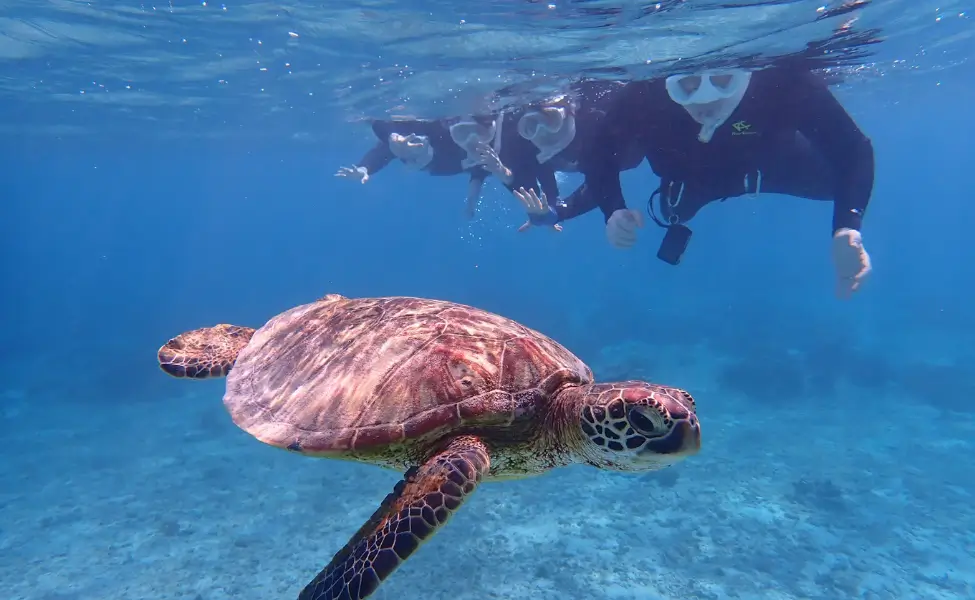
Sea turtles appear frequently in Miyako’s waters.
Green turtles dominate encounters with occasional hawksbills.
Shigira Beach provides the island’s most reliable turtle snorkelling.

Turtles feed on seagrass in water 3 to 10 metres deep.
Morning sessions offer highest success rates before boat traffic increases.
Aragusuku Beach and Waiwai Beach also deliver consistent turtle sightings for snorkellers.

Waiwai Beach sits near Imgyo Marine Garden, allowing combined visits.
No equipment rental exists at Waiwai, so bring your own gear or visit from Miyako town where rental shops charge 1,500 to 2,000 yen for full snorkel sets.
Yabiji Reef System
The Yabiji reef system extends 17 kilometres north of Ikema Island.
This coral group contains over 100 individual reef formations, making it Japan’s largest.
During spring low tides, portions of Yabiji break the surface.
Boat tours from Ikema Port visit Yabiji for snorkelling and diving, costing 8,000 to 12,000 yen including equipment and lunch.
Practical Details
Water temperature ranges from 22 degrees in February to 29 degrees in August.
Most divers use 5mm wetsuits November through April, 3mm suits May through October.
Accommodation ranges from guesthouses at 4,000 yen per night to resort hotels exceeding 20,000 yen.
Rental cars cost 5,000 to 7,000 yen daily and provide essential mobility for reaching multiple dive sites.
Read our in depth Okinawa posts here:
- 7-Day Okinawa Itinerary for Beaches, Culture and Island Life
- Destination Okinawa: Japan Island Adventures
- 20 Okinawan Islands to Visit: A Guide to Japan’s Hidden Gems
- 7 Unique Experiences in Okinawan Culture: A Must-Do List for Your Trip
- 7 Best Places to Visit in Okinawa for an Unforgettable Holiday
- Things to Do in Okinawa: Unmissable Experiences And Attractions
- What to do in Miyakojima?
Ogasawara Islands
Japan’s Galápagos
The Ogasawara Islands float 1,000 kilometres south of Tokyo.
Access requires a 24-hour ferry journey from Takeshiba Passenger Terminal in Tokyo, as no airports exist.
The Ogasawara Maru departs approximately once weekly, varying by season.

Ferry tickets cost 25,560 yen one way in second-class berths, 56,490 yen for first-class cabins.
The minimum trip duration spans six days due to ferry schedules.
Typical itineraries involve 24 hours outbound, three days on island, 24 hours return.
UNESCO designated these islands a World Natural Heritage site in 2011 due to unique evolution in isolation.
Endemic species are unique to specific areas.
Diving Conditions
Water visibility routinely exceeds 30 metres, often reaching 40 to 50 metres.
Locals describe the water colour as “Bonin Blue” for its distinctive sapphire clarity.
Diving operates year-round with water temperature ranging from 19 degrees in winter to 28 degrees in summer.

Chichijima Island hosts the primary tourism infrastructure.
Approximately 15 dive shops operate on the island.
Papa’s Diving Studio ranks among the most established and offers English support.
Two-tank boat dives cost 15,000 to 18,000 yen.
Three-tank full-day trips run 20,000 to 24,000 yen.
Whales and Dolphins
Humpback whales migrate through from January to April.
Sperm whales inhabit deeper waters off Chichijima’s southeast coast from May through October.
Whale watching tours cost 6,000 to 8,000 yen for half-day trips.
Dolphins maintain year-round presence.
Swimming tours with dolphins cost 8,000 to 12,000 yen for half-day sessions.
Success rates exceed 90 percent as guides use radio communication to locate pods.
Accommodation and Costs
Chichijima offers accommodation from guesthouses at 6,000 yen per night including meals to small hotels at 12,000 to 18,000 yen.
Advance booking essential, particularly for summer months.
Bicycle rental (1,000 yen daily) or scooter rental (3,000 yen daily) provides island transport.
The limited ferry schedule and trip duration mean Ogasawara demands significant time and financial commitment.
Budget approximately 100,000 to 150,000 yen per person for ferry, accommodation, diving, and meals.
Izu Peninsula and Osezaki
Tokyo’s Accessible Diving
The Izu Peninsula extends into the Pacific Ocean 100 kilometres southwest of Tokyo.

Atami, the peninsula’s northern gateway, sits 45 minutes from Tokyo Station via Shinkansen bullet train.
This accessibility makes Izu Japan’s most convenient quality diving for Tokyo residents and visitors.
Osezaki occupies a narrow peninsula on the western Izu coast in Numazu City.
The site offers shore diving from a sheltered bay with depths ranging from 5 to 60 metres.
The bay’s eastern side provides calm conditions suitable for beginners whilst the western outer reef challenges experienced divers.
Marine Life and Conditions
Mount Fuji dominates the northern horizon on clear days, creating distinctive surface intervals.

Over 600 fish species have been documented at Osezaki.
Facilities and Access
Osezaki has the Osper Dive House and several other operators.
They provide hot showers, changing rooms, gear storage, and meals.
Equipment rental available.
English support limited, basic Japanese helps.
Two-tank shore dives cost 10,000 to 13,000 yen including weights and air.
Water temperature ranges from 14 degrees in February to 26 degrees in September.
Access from Tokyo involves Shinkansen to Atami (45 minutes, 3,880 yen), then local train to Numazu (25 minutes, 320 yen), then bus to Osezaki (50 minutes, 1,000 yen).
Rental cars from Atami or Numazu provide easier access, costing 5,000 to 7,000 yen daily.
Accommodation in the Osezaki area includes dive-friendly guesthouses at 7,000 to 9,000 yen per night with meals.
Numazu city offers business hotels at 5,000 to 8,000 yen without meals.
Mikurajima Island
Wild Dolphin Encounters
Mikurajima Island sits 200 kilometres south of Tokyo in the Izu Islands chain.
The island specialises in wild dolphin encounters, attracting swimmers and free divers seeking close interaction with bottlenose dolphins.

Ferry access from Tokyo’s Takeshiba Passenger Terminal takes 7 hours overnight, arriving early morning.
One-way fares cost 7,560 yen in second class, 13,610 yen in first class.
The Dolphin Pod
A resident pod of approximately 120 bottlenose dolphins inhabits the waters around Mikurajima.
Dolphins rest in the island’s bays during morning hours, making this the optimal time for encounters.
Tour operators use small boats to locate pods, then allow swimmers to enter the water and attempt approach.
Success rates exceed 95 percent for seeing dolphins.
Tour Details
Tours operate from May through November when sea conditions permit.
July through September provides calmest water and highest success rates.
Tour costs range from 8,000 to 12,000 yen for half-day sessions including boat, guide, and wetsuit rental.
The island lacks beaches.
Rocky cliffs and boulders line the coast, requiring careful water entry.
Strong swells affect the island frequently.
Guides assess conditions daily and cancel tours when waves exceed safe thresholds.
Participants need comfortable swimming ability and reasonable fitness.
Accommodation
Approximately 10 guesthouses operate on Mikurajima.
Accommodation costs 8,000 to 10,000 yen per night including meals.
Advance booking essential as capacity remains limited.
The island has one small shop and no restaurants outside guesthouses.
Wagu-no-Hama Beach
Family-Friendly Snorkelling
Wagu-no-Hama Beach sits on the Shima Peninsula in Mie Prefecture, roughly 150 kilometres southwest of Nagoya.
The beach lies within Ise-Shima National Park, a protected area known for coastal scenery and pearl cultivation.
This site specialises in family-friendly snorkelling.
Calm, shallow water extends 50 to 100 metres from shore before reaching significant depth.
Parents can stand in waist-deep water whilst children explore nearby coral patches and fish schools.

Conditions and Marine Life
Crystal clarity provides easy observation of marine life without venturing into deeper areas.
Visibility typically reaches 10 to 15 metres during summer months.
The beach maintains facilities including toilets, changing rooms, and freshwater showers.
Safety and Seasonal Information
A designated swimming area marked by buoys keeps swimmers away from boat channels.
Lifeguards monitor the area from late June through early September.
Outside these months, no supervision exists and facilities close.
Water temperature ranges from 16 degrees in May to 28 degrees in August.
Late July through August provides warmest water and calmest conditions.
September maintains comfortable temperatures with fewer crowds.
Access and Accommodation
Access from Nagoya involves JR or Kintetsu lines to Toba Station (1.5 hours), then local bus to Wagu (20 minutes).
Total cost approximately 3,000 yen one way.
Rental cars from Nagoya cost 6,000 to 8,000 yen daily and provide flexibility for exploring the Shima Peninsula.
If you do drive know that there is one road to the beach and it ends with a car park.
If the car park is full, you cannot enter so get there early.

Accommodation in the Shima area ranges from minshuku at 8,000 yen per night with meals to resort hotels at 15,000 to 30,000 yen.
The nearby towns of Toba and Kashikojima offer additional lodging options.
Wagu-no-Hama operates seasonally.
Peak season runs July through August when all facilities function.
Shoulder seasons in June and September offer snorkelling but limited facilities.
October through May sees the beach largely empty with no services.
Experienced divers will find limited interest as depth and marine diversity remain modest.
The beach serves a specific niche rather than competing with Okinawa’s more dramatic sites.
Planning Your Japanese Diving Adventure
The nine sites listed above are expert recommendations.
They focus on marine biodiversity, accessibility, and reliable encounters.
You can enjoy gentle snorkelling in safe bays, meet manta rays, or tackle tough dives.
These spots offer a way into Japan’s amazing underwater world.
A country’s diversity means you don’t have to choose between tropical warmth and temperate wilderness.
