
A well-worked Japan travel checklist makes the difference between arriving anxious and arriving ready.
Japan is one of the most rewarding trips you can plan, but it comes with more moving parts than almost any other destination.
Visas to check.
Tickets that sell out months before you arrive.
Medicine rules strict enough to catch people out at customs.
Transport passes that may or may not be worth buying.
Mobile data to arrange before you land.
Most first-time visitors start researching and quickly find themselves buried in contradictory advice with no clear sense of what order to do things in.
This Japan travel checklist cuts through that.
It organises every important pre-departure task by planning stage, so you know exactly what needs doing six months out, what to tackle at two months, and what to finish in the final two weeks.
Work through it in order and you arrive in Japan with nothing left to worry about.
Six Months Before Departure
Passport and Visa
Check your passport expiry date before you book anything else.
Japan requires only that your passport covers your actual stay, but airlines and booking platforms often apply their own validity rules and may reject a passport with less than six months remaining.
If yours expires within a year of your travel dates, renew it now before committing to flights.
Most visitors from the UK, US, Canada, Australia, Ireland, and across Europe do not need a visa.
Citizens of approximately 74 countries can enter visa-free for up to 90 days as a temporary visitor, provided they have one spare blank page in their passport for the entry stamp.
You may be asked at the border for proof of a return ticket or sufficient funds for your stay.
If your nationality requires a visa, start the application process at least two months before departure.
Japan also offers an eVISA online system for eligible travellers who need a short-term tourism visa and live in certain countries, including the UK, US, Australia, and Canada.
Visa-exempt travellers do not need to use this.
Travel Insurance
Book your travel insurance early, not in the final days before you fly.
Medical treatment in Japan without insurance is expensive, and policies purchased at the last minute can carry exclusions for pre-existing conditions that only become relevant when you need to use the cover.
Look for a policy that includes medical evacuation, trip cancellation, and natural disaster cover.
Japan sits in an active seismic zone and major earthquakes are not uncommon, so this last point matters more than it would for most other destinations.
Flights and Accommodation
Booking flights six months out gives you the widest choice of seats, routes, and prices.
Once your flights are confirmed, book accommodation straight away.
Popular ryokans in Kyoto, guesthouses in the Japanese Alps, and well-reviewed city hotels in Tokyo fill quickly, especially during cherry blossom season in late March and early April.

Many properties only open reservations three to six months ahead, so set calendar reminders for each release date and check back.
Choose free-cancellation options where possible while your itinerary is still taking shape.
Note down your first night’s address in Japanese before you travel as Japanese immigration will ask for it on arrival.
Vaccinations
Book a travel health appointment six to eight weeks before departure.
Japan has no entry vaccination requirements, but your doctor or travel clinic may recommend boosters based on your health history.
Some vaccine courses involve two or more doses spread several weeks apart, so this is not a task to leave until the month before you fly.
Two to Three Months Before Departure
Studio Ghibli Park Tickets
Studio Ghibli Park catches many first-time visitors by surprise because it is not in Tokyo.
It sits in Nagakute, Aichi Prefecture, roughly an hour east of Nagoya by train, which means planning a separate leg of your trip if you want to include it.

The park now covers five themed areas: Ghibli’s Grand Warehouse, Hill of Youth, Dondoko Forest, Mononoke Village, and Valley of Witches.
Ticket types vary by area access, so check carefully before booking.
New tickets go on sale on the 10th of each month at 2pm Japan time, covering the following month, and popular dates sell out within minutes.
Book through the official overseas ticketing site as soon as dates open for your travel period.
If standalone tickets are already gone, tour packages that bundle entry with transport from Nagoya are often still available when direct tickets are not.
Tokyo Disney Tickets
Tokyo Disneyland and Tokyo DisneySea both require advance booking through the official Tokyo Disney Resort website.
Most visitors buy a fixed-date one-day ticket for either Tokyo Disneyland or Tokyo DisneySea.

Park-hopper tickets are sometimes available during limited periods, so check the current ticket types before planning around them.
Do not assume you can buy at the gate but there are other services you can use if needed.
Sumo Tournament Tickets
Japan holds six Grand Sumo Tournaments each year.
Three take place in Tokyo, with the others rotating through Osaka, Nagoya, and Fukuoka.
Tickets go on sale four to eight weeks before each tournament and popular sessions sell out fast.

The opening and closing days, weekend matches, and late-tournament bouts featuring the higher-ranked wrestlers are always the first to go.
Book through the official Ticket Oosumo website.
If you would rather avoid the pressure of a timed release, pre-order services will purchase tickets on your behalf as soon as sales open.
Compare box seats near the ring with arena seating before you decide, as the price and experience differ considerably.
The Japan Rail Pass Decision
The JR Pass comes up in almost every Japan planning conversation, but it is not automatically worth buying.
In October 2023 the price increased by approximately 70 percent.
The seven-day ordinary pass now costs JPY 50,000, the 14-day pass JPY 80,000, and the 21-day pass JPY 100,000.
At those prices, the pass pays for itself only if your itinerary involves multiple long-distance Shinkansen journeys across different regions.
A return trip between Tokyo and Kyoto alone costs around JPY 28,000.

Add a leg to Hiroshima, Osaka, and a day trip to Kobe, and a seven-day pass begins to justify itself.
If your trip stays mostly within one or two cities, individual tickets will almost certainly cost less.
The pass does not cover Nozomi and Mizuho services in the standard way.
JR Pass holders can use them only by buying an additional Nozomi Mizuho ticket.
The pass also covers very little of the metro or private rail networks inside cities.
Use a fare comparison tool for your specific planned routes before committing.
If you decide to buy, purchase the pass before leaving home through the official Japan Rail Pass website or an authorised overseas seller.
Activation happens at a JR office in Japan, and you have three months from purchase to start using it.
Popular Tours and Restaurant Reservations
Two to three months out is the right window for any reservation-only restaurant, tea ceremony, guided experience, or touring activity in high demand.
Many sought-after experiences release bookings 90 days in advance and fill within hours.
Mount Fuji day tours, particularly those operating during summer climbing season, sell out quickly on days with clear weather forecasts.

Book early and check cancellation terms so you can rebook if conditions are poor on your original date.
Four to Six Weeks Before Departure
Medicine Rules for Japan
Japan enforces stricter rules on medicines than most visitors expect, and it is worth checking your own supplies well before you fly.
| Medicine type | Permitted quantity without import certificate |
|---|---|
| Prescription medicines | Up to one month’s supply |
| Over-the-counter medicines | Up to two months’ supply |
| External use medicines (creams, patches) | Up to 24 items |
Several medicines that are widely available at home without a prescription are banned outright in Japan, regardless of whether you carry a doctor’s note.

The most commonly flagged include:
- Products containing pseudoephedrine (Sudafed, Actifed, Vicks inhaler)
- ADHD medications including Adderall and Dexedrine
- Codeine above permitted trace quantities
If you need narcotic-based prescription medication such as morphine or oxycodone for pain management, you must apply for an import certificate from Japan’s Ministry of Health, Labour and Welfare at least two weeks before departure.
That process can take up to three weeks, so start early.
Keep all medicines in original packaging and carry your prescription and a doctor’s letter for anything that could raise questions at customs.
Other Items You Cannot Bring Into Japan
Japan enforces strict biosecurity rules to protect its agricultural industry from pests and disease, and these apply to personal luggage as much as to commercial shipments.
The items most commonly confiscated from arriving tourists include all meat and meat products (cured meats, sausages, ham, and jerky are the most frequent offenders), fresh fruit and vegetables, dairy products such as cheese and butter, and plants or cut flowers with soil or roots attached.

If you are unsure whether something in your bag is permitted, declare it on your customs form rather than leaving it blank.
Declaring gets you a brief conversation at the desk.
Concealing risks a fine.
The practical trap for most travellers is food packed as an in-flight snack or as a gift, particularly charcuterie and cheese, which are among the most common items stopped at Japanese customs.
Suica or Pasmo
Every visitor to Japan needs an IC card.
Suica and Pasmo are rechargeable smart cards that work across trains, buses, and metro networks throughout Japan, and also function as contactless payment at convenience stores, vending machines, and a wide range of shops and cafes.
The practical difference between the two is small.
Suica is issued by JR East and can be loaded directly into Apple Wallet on compatible iPhones before you leave home, which makes it the most convenient option for most international visitors.
Pasmo is issued by Tokyo Metro and operates on the same networks.
You do not need both.
Visitors without an eligible iPhone can pick up a physical Suica or Pasmo from any major station ticket machine on arrival in Japan.
Mobile Data
Sort your mobile data before you fly rather than hunting for a solution after a long-haul flight.

Your three main options are:
- eSIM: Downloads directly to a compatible phone. You keep your regular number active for calls and texts. Works only on newer unlocked phones that support dual SIM. Buy and install before departure so you have data the moment you land.
- Local SIM card: Replaces your regular SIM. Cheaper than roaming, good data allowances, but you lose your home number while it is inserted. Requires an unlocked phone.
- Pocket WiFi: A small portable device that creates a WiFi hotspot. Good for groups or for connecting a tablet and laptop alongside your phone. Requires charging and carrying an extra device. Available to pick up at the airport on arrival.

Book whichever option you choose at least two weeks before departure.
Pocket WiFi providers need your order in advance to have the unit ready for collection.
Airport Transfer
Decide how you are getting from the airport to your hotel before you land, not after a twelve-hour flight.
Tokyo’s two main international airports are not interchangeable and serve different parts of the city.
| Airport | City | Distance | Fastest public transport |
|---|---|---|---|
| Narita (NRT) | Tokyo | Approx. 60km | Keisei Skyliner, approx. 40 min to Ueno |
| Haneda (HND) | Tokyo | Approx. 15 to 20km | Keikyu Line or Monorail, approx. 30 min |
| Kansai (KIX) | Osaka | Approx. 50km | Haruka express, approx. 60 min |
| Kansai (KIX) | Kyoto | Approx. 75km | Haruka express, approx. 75 min |
| Centrair (NGO) | Nagoya | Approx. 35km | Meitetsu railway, approx. 30 min |
If your outbound and return flights use different Tokyo airports, allow at least 90 minutes to two hours for the transfer between Narita and Haneda.

Pre-booked private transfers remove all route uncertainty and are a particularly good option for late-night arrivals, families travelling with luggage, or anyone whose first priority after landing is to go straight to the hotel without navigating a rail network.
Two Weeks Before Departure
Visit Japan Web
Visit Japan Web is the Japanese government’s online pre-registration system for immigration and customs.
It is not mandatory but it is strongly worth completing because it lets you use automated kiosks on arrival, skipping the paper forms and often shortening the queue significantly during peak arrivals.
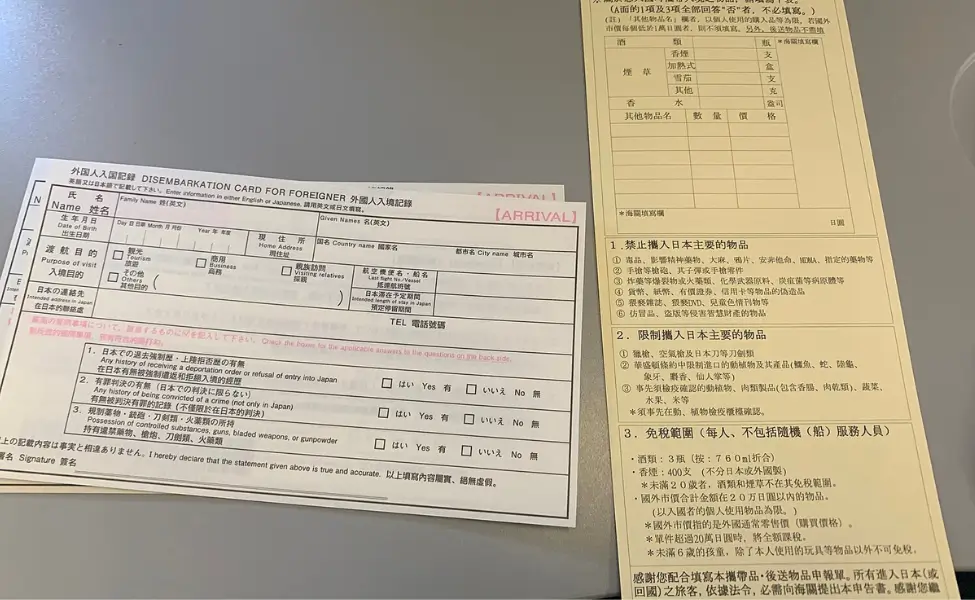
The quarantine procedure referenced in older travel articles no longer exists and has not been required since April 2023.
You only need to complete the immigration and customs sections.
Finish your registration at least 24 hours before your flight and screenshot your QR code in case you have no signal at the airport.
Money Preparation
Cashless payments now cover well over 40 percent of consumer spending in Japan.
Visa and Mastercard are accepted at hotels, chain restaurants, department stores, convenience stores, and most tourist-facing businesses in cities.
Apple Pay and Google Pay work wherever contactless terminals are available, which in central Tokyo and Osaka covers the majority of modern shops and cafes.
Cash still matters at smaller local restaurants, rural shops, traditional inns, and shrines, so carry JPY 5,000 to 10,000 as a daily buffer.
For withdrawals, 7-Eleven (Seven Bank) ATMs are the most reliable option for foreign cards, operating around the clock and accepting virtually all Visa and Mastercard cards.
Japan Post Bank ATMs in post offices work equally well but close overnight.
FamilyMart, Lawson, and AEON Bank ATMs are also increasingly compatible with foreign cards.

Standard Japanese bank ATMs at Mizuho and MUFG branches generally do not accept international cards.
Notify your home bank of your travel dates before you fly to prevent your card being blocked when the first Japanese transaction appears.
Carry at least two cards in case one is declined or fails.
Set up a Wise Card
The Wise card is a highly recommended, low cost option for travelling in Japan.
It offers mid market exchange rates, low fees, and wide acceptance.
You can hold and convert Japanese yen instantly in the app, and it also allows free ATM withdrawals up to a set limit.
For Japan, another big advantage is that it works as a physical card, contactless card, and digital card through Apple Pay or Google Pay at many shops, restaurants, and convenience stores.
Essential Apps
Download these before you fly so you are not relying on airport WiFi to set them up:
- Google Maps or Apple Maps: Both work well for Japan navigation including public transport
- Google Translate: Download the Japanese language pack for offline use
- Hyperdia or Navitime: Specialist Japan rail search tools for checking fares and timetables
- Your airline app: Enable push notifications for schedule changes
Final Checklist
Run through these tasks in the final two weeks and tick each one off:
- Passport checked and accessible
- Travel insurance documents saved digitally and printed
- Visit Japan Web registration completed, QR code screenshotted
- First night’s accommodation address saved in Japanese script
- IC card loaded or eSIM installed and tested
- Airport transfer booked and confirmation saved
- All theme park and experience tickets downloaded or printed
- Medicines checked against Japan’s permitted list, import certificate obtained if needed
- Bank notified of travel dates, cards tested and working
- Cash in yen obtained or multi-currency card loaded
- Apps downloaded with offline packs where available
- Government travel advice page for Japan checked for your nationality
Everything on this list can be handled from home before you leave, which means your first full day in Japan can be spent actually enjoying it rather than solving problems you could have handled weeks earlier.