

Some of Japan’s most breathtaking views aren’t seen from observation decks or mountain trails.
They appear from train windows as carriages twist through gorges, follow coastal cliffs, and cross valleys where traditional villages cling to mountainsides.
These journeys reveal a Japan that highways never touch.
The country’s railway network extends far beyond the famous shinkansen.
Regional lines take passengers through changing landscapes.
In spring, cherry blossoms mirror mountain rivers.
Summer brings lavender fields reaching for distant peaks.
In autumn, forests burst with colour. Winter shows snow-dusted coastal villages.
On these routes, the journey itself becomes the destination.
Whether you want stunning Alpine views, coastal sights, or the calm of rural Japan, these eight train routes offer experiences that stay with you long after the trip.
Quick Reference: Train Routes in Japan at a Glance
| Route | Region | Journey Time | Best Season | Key Features |
|---|---|---|---|---|
| Sagano Scenic Railway | Kyoto | 25 minutes | Autumn (Nov to Dec) | River gorge, vintage carriages |
| Lavender Express | Hokkaido | 2 hours | Summer (Jul) | Flower fields, seasonal service |
| Gono Line | Tohoku | 2 to 5 hours | Year round | Coastal views, UNESCO heritage |
| Sanriku Railway | Iwate | 4+ hours | Spring & autumn | Pacific coast, recovery story |
| Oigawa Steam Locomotive | Shizuoka | 80 minutes | Spring & autumn | Working steam, tea plantations |
| Ibusuki no Tamatebako | Kyushu | 50 minutes | Year round | Volcanic bay, folklore theme |
| Kurobe Gorge Railway | Toyama | 80 minutes | Autumn (Oct) | Alpine ravine, 41 tunnels |
| Tadami Line | Fukushima to Niigata | 4+ hours | All seasons | Mountain rivers, photo spots |
1. Sagano Scenic Railway: Kyoto’s Vintage Gorge Train
Overview
Mid-November to early December for autumn colours.
Board a vintage carriage along the Hozu River, and you’ll step into Japan’s railway history.
The Sagano Scenic Railway uses vintage trains to glide through western Kyoto’s wooded ravines.
It offers a 25-minute journey of slow-paced views between Arashiyama and Kameoka.

These aren’t replica trains.
The locomotives and carriages date from the Showa era, featuring wooden benches and, in the “Rich Car,” no windows at all.
Just open sides and a glass ceiling expose passengers directly to the gorge.
Pace
The trains slowly move through the mountains.
This gives you plenty of time to enjoy the changing seasons.
Seasonal highlights
Spring brings pink cherry blossoms.
Summer offers verdant canopies.
But autumn steals the show.

From mid November through early December, forested slopes ignite in reds and golds that photographers capture from every angle.
Planning your visit
Access requires reaching JR Saga Arashiyama Station (15 minutes from Kyoto Station), then walking one minute to Torokko Saga Station.
Tickets sell out weeks in advance during autumn, so book online as early as possible.
The journey fits well with Arashiyama’s bamboo groves and the Hozu River boat ride.
This ride leaves close to the railway’s Kameoka terminus.
Budget around 880 yen for adults, 440 yen for children.
2. Hokkaido’s Lavender Express: Summer Flower Train
Overview
Early to mid July for peak lavender bloom.
Central Hokkaido transforms into a colour explosion each summer, and the Lavender Express delivers front row seats.
This limited express connects Sapporo and Furano directly.

It takes just under two hours, passing through beautiful countryside that blooms from late June to August.
The purple liveried front car announces its purpose before you board.
Onboard features
Inside, large windows throughout the five car train frame passing flower fields.
The dedicated lounge car offers rotating seats facing the scenery.
Every seat includes power outlets and retractable tables, useful for the two hour ride through Hokkaido’s agricultural heartland.
Flowers and stops
Furano’s lavender peaks in early to mid July, when fields at Farm Tomita glow purple beneath summer skies.

But lavender grows alongside poppies, lupins, and salvia.
This mix creates striped hillsides that look more like paintings than photos.
The train stops at several stations for flower farms.
Planning your visit
The train operates weekends only from early June through late September, with daily service during peak bloom (mid June to August).
The Japan Rail Pass covers the route, though reserved seats require an 840 yen supplement.
Without the pass, expect to pay around 5,000 yen one way. Book seats at least two weeks ahead during July, as flower season draws crowds.
Think about joining your trip with the slower Furano Biei Norokko Train.
3. Gono Line: Tohoku’s Coastal and Mountain Railway
Overview
Year round, with spring apple blossoms and autumn colours as highlights.
The Gono Line doesn’t rush.
The 147-kilometre route from Higashi Noshiro in Akita to Kawabe in Aomori takes two to five hours, depending on your train.
It runs right by the Sea of Japan, so waves sometimes spray the passing carriages.

This route rewards patience with sustained immersion in coastal wilderness and traditional rural life.
Shirakami Sanchi and coast
Much of the line runs adjacent to Shirakami Sanchi, a UNESCO World Heritage Site protecting one of Asia’s last virgin beech forests.
Stations double as gateways to this pristine environment.
At Juniko Station, buses carry passengers to the Twelve Lakes area, where Aoike’s mysterious blue waters create an almost unnatural turquoise that photographers capture in every season.

The coastline itself competes for attention.
At Senjojiki Station, wave-carved rock shelves stretch into the ocean.
These platforms are popular with locals and tourists, especially when the weather is calm.
Fukaura Station has earned recognition for sunset views, when the descending sun paints the Sea of Japan in golds and oranges that stop conversation.
Planning your visit
Regular local trains serve commuters alongside tourists at a slower pace.
The full journey on a local train takes around five hours.
Resort Shirakami services cut this to three hours between key cities.
The JR East Pass covers this route.
Spring brings apple blossoms around Hirosaki (accessible via Hirosaki Station), while autumn paints the beech forests in gold.
Winter operations continue, though heavy snow occasionally causes delays.
4. Sanriku Railway: Japan’s Resilient Coastal Line
Overview
Spring (for cherry blossoms) or autumn (for clear Pacific views).
In Iwate, a railway rebuilt after disaster now runs by the Pacific, sharing tales of resilience with tourists who seek coastal beauty.
The Sanriku Railway Rias Line runs 163 kilometres from Kuji to Sakari.
This makes it Japan’s longest non-JR railway, and it has an inspiring survival story.

When the Great East Japan Earthquake struck in March 2011, the tsunami destroyed stations, swept away five kilometres of track, and damaged the line in 300 locations.
Recovery and return
Yet just five days later, operators restarted service on an undamaged northern section, providing essential transport for isolated communities.
That rapid response symbolised the region’s determination to recover.
The full restoration was complete by April 2014.
The last section, from Miyako to Kamaishi, reopened in March 2019 after JR East handed it over to Sanriku Railway.
Route highlights
Today, the line showcases both natural beauty and human perseverance.
Trains wind along dramatic ria coastline, where narrow inlets carve between steep ridges, keeping the Pacific Ocean visible for much of the route.
At Koishihama Station, romance meets wordplay.
The station’s name changed from meaning “little rock” to “yearning.”
Now, it’s a “power spot” for couples. Visitors write wishes on scallop shell plaques, a tradition that draws Japanese tourists seeking relationship blessings.
Planning your visit
The complete ride takes over four hours, though most services cover only portions of the line.
Basic fares start from just 300 yen, making this an affordable coastal exploration.
Winter brings the famous kotatsu train.
Passengers can warm their feet under traditional heated tables while enjoying the snowy scenery.
Consider breaking the journey at Miyako or Kamaishi for local seafood and to explore these recovering coastal towns.
5. Oigawa Steam Locomotive: Shizuoka’s Heritage Railway
Overview
Late April to mid-May for tea harvest and cherry blossoms, or October to November for autumn colours.
Step aboard an authentic steam locomotive that has been carrying passengers through Shizuoka’s tea country since the 1930s.
The Oigawa Railway runs one of Japan’s few regular steam services.

It operates almost every day from spring to autumn. Locomotives made between 1930 and 1942 pull vintage Showa era carriages.
The main line links Shin Kanaya Station to Senzu Station.
It runs through tea plantations that turn the hillsides bright green during spring’s first harvest, from late April to mid-May.
Photogenic spots
The route spans about 40 kilometres.
Trains move at a relaxed speed that suits the vintage equipment and lets passengers enjoy the scenery.

Wooden station buildings preserve their original character, and several have appeared in Japanese films and television dramas set in earlier eras.
Ieyama Station is especially photogenic in late March and early April.
That’s when cherry blossoms bloom along a one-kilometre tunnel next to the tracks.
The route also crosses the Oigawa First Bridge, where the train curves elegantly, offering passengers views of their own carriages against the river backdrop.

As you round the bend, open air baths at Kawane Onsen Fureai no Izumi come into view below, occasionally with bathers waving at passing trains.
Planning your visit
All seats on steam services require advance reservations, bookable through the railway’s website or by phone.
The railway also operates special Thomas the Tank Engine themed services during summer, drawing families from across Japan.
From Tokyo, take the Tokaido Shinkansen to Kakegawa, then transfer to the JR Tokaido Main Line for Kanaya.
The Japan Rail Pass covers travel to Kanaya but not the Oigawa Railway itself.
6. Ibusuki no Tamatebako: Kyushu’s Folklore Train
Overview
Year round, though spring and autumn offer the clearest views of Sakurajima.
When this unique black and white train pulls into stations, white smoke puffs from above the doors.
This nods to the famous story of Urashima Taro and his magical treasure box that released white smoke when opened.

The 50-minute ride runs between Kagoshima Chuo and Ibusuki stations.
It follows the eastern coast of the Satsuma Peninsula along Kinko Bay.
The route provides ongoing views of the water, looking towards Sakurajima.
This is one of Japan’s most active volcanoes, and its smoking cone stands out in the skyline.
Design and seating
On clear days, the contrast between blue bay waters and the volcanic mountain creates the kind of view that stops conversation.
Designer Eiji Mitooka crafted an interior filled with warm woods.
He used southern Kyushu cedar and teak, which are usually meant for yacht building.
The colour scheme matches the train’s exterior.
It has white surfaces on the ocean side and black on the mountain side.

A golden stripe connects the two.
Seating varies from standard pairs to sofas, counter seats facing the water, and special child sized furniture.
A playpen accommodates families with babies, making this one of Japan’s most family friendly scenic trains.
Books line small shelves, and the attention to detail extends to commemorative postcards available onboard for stamping at each station.
Sand baths and side trip
The train connects to Ibusuki’s famous sand bathing beaches, where naturally heated volcanic sand provides a unique spa experience.
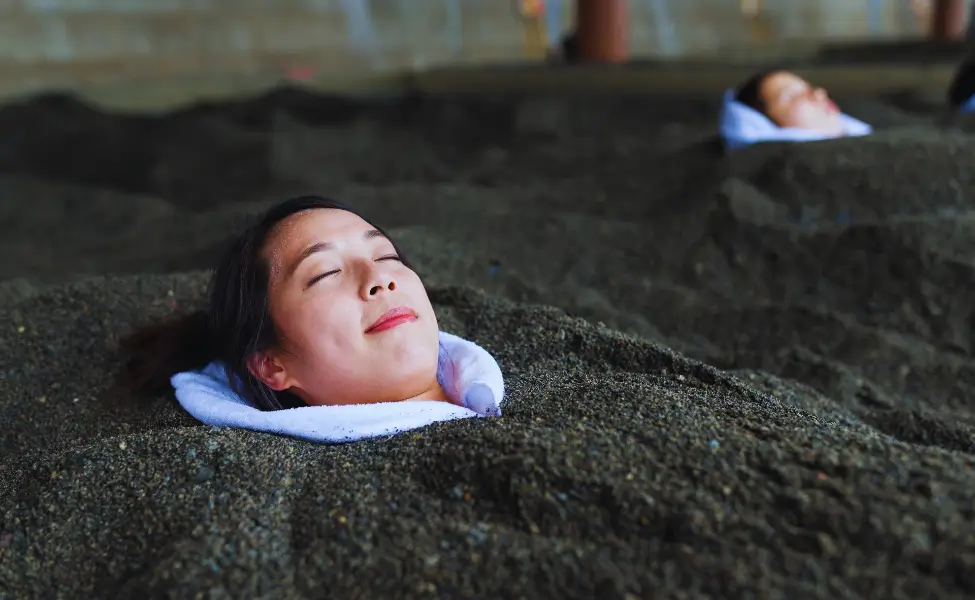
Attendants bury visitors up to their necks in warm black sand for a therapeutic treatment found nowhere else in Japan.
Some visitors go 20 minutes more to Nishi Oyama Station.
It’s Japan’s southernmost JR station.
On clear days, you can see Mount Kaimondake clearly from there.
Planning your visit
All seats require reservations.
Three departures run daily in each direction.
The Japan Rail Pass covers this ride at no additional cost beyond the standard reservation.
The approximately 1,930 yen fare makes this an affordable half day excursion from Kagoshima.
Book online through JR Kyushu’s website or at major JR stations.
The train rarely sells out except during major Japanese holidays (Golden Week, Obon, New Year).
7. Kurobe Gorge Railway: Alpine Adventure Train
Overview
October for peak autumn foliage.
Ride into one of the Northern Japan Alps’ most dramatic ravines on narrow-gauge trolley cars not meant for tourism.

This line was first built for the Kurobe Dam construction.
It opened to sightseers in 1953.
Its industrial character adds to the experience instead of taking away from it.
Open sided carriages with simple four person bench seats comprise most of the train.
Wind flows freely through these cars, carrying the scent of forest and river while passengers absorb views of the steep walled gorge.
Enclosed cars provide weather protection for those who prefer comfort over atmosphere.
The 20 kilometre stretch from Unazuki to Keyakidaira stations takes approximately 80 minutes, with trains crawling along at just 16 kilometres per hour.
Bridges and tunnels
The route threads through 41 tunnels and crosses 21 bridges spanning the Kurobe River far below.
At Atobiki Bridge, passengers peer down from 60 metres above the valley floor.

The name translates roughly as “backing away” because historical mountain climbers supposedly retreated in fear when encountering such depths. Near Sarutobi Gorge, the Babadani River meets the Kurobe.
The joining waters create churning rapids that you can see from the moving train.
Onsen stops and seasons
Stations along the route offer access to natural hot springs tucked into the mountainside.
Kuronagi Station sits 20 minutes’ walk from Kuronagi Onsen, where outdoor baths mix genders in traditional style.
The blue tinted Atobiki Bridge spans the gorge nearby, its colour contrasting sharply with autumn foliage.

At Kanetsuri Station, the “ten thousand year old snow” pile can last into winter.
This happens even with summer heat, thanks to deep shade and high altitude.
Autumn draws the largest crowds, particularly in October when hillside forests explode into red, yellow, and orange that rivals anywhere in Japan.
Planning your visit
Book at least one month in advance for October weekends.
Spring brings fresh green growth, while early season visits may encounter lingering snow.
The railway operates from late April through November only, closing during winter when snow makes the route impassable.
From Tokyo, take the Hokuriku Shinkansen to Kurobe Unazuki Onsen Station.
This takes about 2.5 hours.
Then, transfer to the Toyama Chiho Railway for Unazuki Onsen Station.
That ride lasts 25 minutes.
8. Tadami Line: The Most Romantic Railway
Overview
Each season shows unique beauty.
In spring, cherry blossoms bloom.
Summer brings lush green, autumn displays vibrant colours, and winter coats everything in snow.
The Tadami Line has earned recognition as “the most romantic railway in the world,” and a single ride explains why.

This 135 kilometre route connects Aizu Wakamatsu in Fukushima Prefecture with Koide in Niigata Prefecture, traversing some of Japan’s most remote mountain territory.
The ride takes over four hours to complete, with trains stopping at all 36 stations along the way.
Only three services daily run the entire route, operating at a pace that matches the unhurried rhythm of the mountain villages they serve.
Windows frame continuous views of the Tadami River as it curves through forested valleys and beneath dramatic steel girder bridges.
Iconic viewpoint
The most photographed location sits near Aizu Miyashita Station, where the First Tadami River Bridge spans the water with mountains rising behind.

To reach the viewpoint at Mishima juku, visitors must alight at the station and take a brief bus ride departing at 8:10 on most days (not Sundays).
This viewpoint shows the entire scene. A train crossing a bridge over the river.
It’s framed by seasonal colours like cherry blossoms, summer green, autumn fire, or winter snow.
Along the route
Aizu Yanaizu Station is along the route to Enzoji Temple.
This temple is famous as the birthplace of the akabeko, a red cow good luck charm found throughout the Aizu region.
The temple overlooks the Tadami River from its hillside position.
Visitors can also board a unique sightseeing boat modelled after a steam locomotive for a 40 minute cruise offering river perspectives impossible from the train.
Planning your visit
The Japan Rail Pass covers this line, making it an affordable adventure for pass holders willing to invest time in scenic travel.
From Tokyo, take the Tohoku Shinkansen to Koriyama.
This takes about 80 minutes.
Then, transfer to the Ban’etsu West Line for Aizu Wakamatsu, which takes around 70 minutes.
Riding the Tadami Line is worth it.
The landscapes change all the time as the train winds through the mountains.
Consider breaking the journey at Aizu Yanaizu Station to explore Enzoji Temple or to take the sightseeing boat ride.
Book early if you’re travelling during autumn foliage season, from mid-October to early November.
Choosing Your Journey
From Kyoto’s mountain gorges to Hokkaido’s flower fields, these eight routes show how varied Japan’s scenery can be.
Each one offers a different experience.
From steam trains and coastal cliffs to quiet rivers and creative designs.
Pick one route in each region to see a side of Japan most tourists miss.
Travelling this way slows you down, but that’s what makes the journey special.
For more details on times and cost you can go to the Japan transit planner.
